Showing posts with label Red Sox. Show all posts

Wednesday, January 08, 2014

St. Francis Prep, CliffsNotes, and MLB's Hall of Fame

Imagine it is 1999 and you are in St. Francis Prep preparing for one of Mr. Goodwin or Mr. Claro’s infamous English exams.

This semester, Claro plans to test you on The Great Gatsby, A Tree Grows in Brooklyn, and A Catcher in the Rye.

You have always been a good English student so you prepare for these exams as you normally would: you read each novel thoroughly, take extensive notes, and study your notes before each test. 

As usual, your hard work leads to good grades.  However, you notice that your peers are scoring similar grades to you with far less effort.  Even notoriously poor students have become English experts.

Suddenly, a dummy who struggles to turn on a light is explaining Gatsby’s green light.

You sense something is amiss and one day your suspicions are confirmed.  Yellow books known as CliffsNotes have infiltrated the school, from west top to east bottom, and revolutionized the way your classmates are studying.

Some students are using CliffsNotes in lieu of reading a book, some students are using them in adjunction to reading the book, and some students did not use them at all.

Usage also varied in frequency.

Some students used them with every book, some students used them with some of the books, and some students never used them with any books.

CliffsNotes became part of Prep's culture.

Poor students utilized CliffsNotes to narrow the gap between their superior peers.   Once relieved to avoid summer school, these students were now filling up honors classes.  Their parents were never more proud.

The increased GPA’s of their unintelligent contemporaries forced honors students into moral dilemmas.  “If I know that I am one of the best English student in SFP without CliffsNotes, do I let some Joe Schmo (or Stro? or Fro? #nodiss) take away my spot in an honors class when the entire student body knows that I am the smartest English student here?”

Suddenly, the honors students began using CliffsNotes too.

Elite before using CliffsNotes, by simply leveling the playing field, these students were attaining never-before-seen heights in the English department.  Prep cashed in on the wave of excitement generated by these extraordinary students, raising tuition nearly double in ten years.

Prep never knew for sure which students used CliffsNotes and which students did not.  More importantly, they did not care.

Increased class participation added value to class discussions that may have otherwise not existed.  The improved English grades made Prep look spectacular.

But slowly, the excitement of the “CliffsNotes Era”—as later deemed by future writers of the Seraph— began to die down.

A decade passes and Prep concludes that there is a CliffsNotes problem on its premises.  They enforce definitive rules prohibiting CliffsNotes while imposing penalties against any student who uses them from this point forward.

This would be a noble effort by Prep’s hierarchy; however, its bearing on students who used CliffsNotes prior to this legal language should be nonexistent.

Were the accomplishments of students who learned during the “CliffsNotes Era” legitimate?  Of course! Their grades still count.  Their diplomas are still valid.

Prep’s administration cannot justify erasing an entire era of student accomplishments out of embarrassment that their employees dragged their heels when confronting the issue.  It is disingenuous at best.  It’s not like Mr. Williams is being asked to give back his 1999 salary.

Had Prep’s concerns about CliffsNotes usage been legitimate, they would have made a better effort to rid the school of them as their prevalence increased.

For years, Channel One ignored the ‘CliffsNotes Era’; now, every day, a new reporter hops aboard his or her moral high horse to diminish what SFP’s students once accomplished.

Never mind the fact that Wikipedia estimates that 2/3 of students as early as 1900 were academically cheating in some fashion or another. For Prep to assume that students from these eras would not have used CliffsNotes had they been available at that time is laughable.

As such, the valedictorian of the Class of 2002 needs no asterisk.  He or she should take her rightful place amongst the great graduates in St. Francis Prep history, no questions asked.  Their legacy should remain unquestioned, their greatness undisputed.

Future generations of Terriers deserve as much.


Nick Xouris’s 2014 HOF Ballot:
Jeff Bagwell, Barry Bonds, Roger Clemens, Mike Piazza, Curt Schilling,
Tim Raines, Mark McGwire, Sammy Sosa, Frank Thomas, Greg Maddux

Thursday, October 02, 2008

Ellsbury's Star Shines Brighter in October

During Game 2 of the 2001 ALDS between Oakland and New York, my brother Billy (10 years old at the time) asked me why the Red Sox never had players like Johnny Damon. Damon underperformed in his lone season with Oakland but remnants of the Kansas City star were evident once October rolled around.

Damon went 4-4 in Game 1 and added two more hits in Game 2—two Oakland victories. He patrolled the outfield gracefully, possessing a game-changing speed atop the order that affected how Roger Clemens and Andy Pettitte operated.

Even Damon’s outs were productive. He saw 22 pitches when making his three outs that night. I’m not sure if Nomar Garciaparra ever saw that many pitches in a week, let alone three at-bats.

I didn’t have an answer for Billy.

The Red Sox, at the time, were finally ending the Carl Everett era while toying with the idea of a young, slim Trot Nixon patrolling center field. The farm system was barren and speed was not common amongst Red Sox. (Everett led the Sox with 9 SB in 2001.) Ironically, Dan Duquette heeded Billy’s advice and signed Damon that off-season. For once, the Red Sox had the prototypical leadoff hitter that they lacked my entire life.

Well, if Billy had a 10-year old younger brother watching last night’s ALDS game with him—which I’m glad he doesn’t, because that would be weird—“Why don’t the Red Sox ever have players like Johnny Damon?” is one question that would most certainly never been asked.

Why?

Because Jacoby Ellsbury is that player.  His presence changes the complexions of postseason games like no other Red Sox player on the roster.


Ask the Colorado Rockies what it was like pitching to Dustin Pedroia and David Ortiz after Ellsbury reached base in 50% of his World Series plate appearances. Ask Mike Napoli (or Matt Napoli, as Buck Martinez calls him) how defenseless he feels with Ellsbury at first and Pedroia at the plate. Ask Mike Scioscia how it felt watching the 8th inning play out after Ellsbury robbed Mark Teixeira’s on a sinking line drive for the first out, preventing a potentially huge inning.

Ellsbury possesses a rare, multifaceted talent that is magnified during low-scoring October baseball. He’s reminiscent of a young Damon spraying line drives to all fields but with stronger plate discipline, more speed, Gold-Glove defense, and a Floyd Mayweather demeanor that flourishes as the lights get brighter.

Last night provided more of what Red Sox fans have grown to expect. Ellsbury went 3 for 5, stealing two bases and scoring a run, bumping his career playoff average up to a ridiculous .400 with a 1.022 OPS. (One of his outs was a triple that was incorrectly ruled a 3-base error) His RBI single in the 9th inning sealed Anaheim’s fate.

Ellsbury has established himself as the catalyst that stirs Boston’s “Dirty Water”. Some players go entire careers without accomplishing a fraction of what Ellsbury has in the seven playoff games he’s started in. Like Pedroia and Kevin Youkilis, two similarly hard-nosed homegrown players who have come to personify the Epstein Regime, the bigger the moment, the brighter Ellsbury’s star shines.

And best of all? 10-year old New Yorkers everywhere went to bed last night asking their older brothers why the New York Yankees don’t have players like Jacoby Ellsbury.

Friday, July 11, 2008

Captain Crutch?


NOTE: I had been contemplating writing about Jason Varitek’s place with the Red Sox for some time now, but his controversial All-Star selection sped up the process for me...


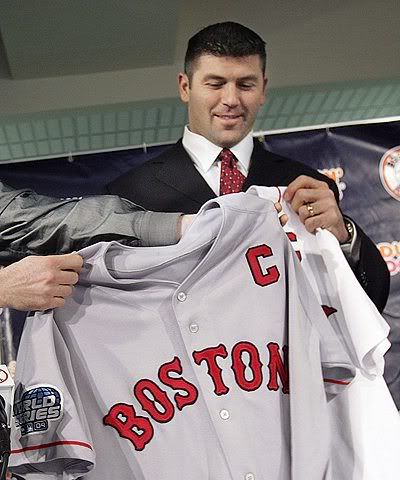
Multiyear contracts for 30+ year old catchers have not been kind to teams throughout history. The list of productive catchers, 35 & older, begins and ends with Carlton Fisk--though Jorge Posada is making a valiant effort to join him. In 2004, the Boston Red Sox signed their then-32 year-old catcher, Jason Varitek, to a 4-year $40 million contract two months after winning their first World Series in 86 years. Varitek was named the captain of the team, only the third Red Sox player to receive the honor since 1923.

The decision to sign Varitek was not as automatic as one might think. To that point, the Epstein regime had been especially opposed to signing aging stars to multiyear contracts regardless of their organizational ties—-especially catchers who are known to have shorter shelf-lives than any other position. The idea being that teams should be paying players for future performance rather than past performance. It's the mindset that sent Cliff Floyd, Pedro Martinez, Johnny Damon, and Derek Lowe looking for work elsewhere at various points throughout Epstein's tenure. But with minimal catching options elsewhere, (rumors of a trade for Brian Schneider surfaced for a while), the Sox were willing to give in to Varitek and agent Scott Boras’s demands.

"It's not every day you're lucky enough to sign a player who embodies everything you want your franchise to be," general manager Theo Epstein said. "When you have that player, you don't let him get away."

Varitek responded with an excellent 2005 season, posting a .281/.366/.489 line in 133 games. The contract was justified for one season, at least. However, as Mets and Yankees fans have witnessed with Pedro Martinez and Johnny Damon, the decline period usually doesn’t surface in year one. It is the later years of the deals where they begin to look bad.

Unfortunately for the Red Sox, Varitek’s decline began even sooner than they had hoped. His injury-plagued 2006 season resembled that of a 34 year old catcher, batting .238/.325/.400. To his credit, the Red Sox’ collapse from contention,just as it did in 2001, coincided with Varitek’s knee injury in August. Varitek bounced back slightly in 2007, recording a respectable .255/.367/.421 season, good for a 103 OPS+. The Red Sox won the World Series for the second time, sweeping the Colorado Rockies. Varitek’s performance behind the plate overshadowed anything he did at the plate.

Now, at age 36 and in the final year of his deal, Varitek is having the worst statistical season of his career. Mired in a 14 for 99 (.141) slump, Varitek is posting splits of .220/.300/.360—numbers that fans once expected from Doug Mirabelli. Oddly enough, he was selected by his peers to represent the American League in the All-Star game for the third time—this in spite of his -2.3 value over replacement player (VORP).

VORP measures the number of runs a player contributes beyond what a replacement-level player at the same position would contribute if he were given the same percentage of a team’s plate appearances. In other words, Varitek’s VORP is the number of runs that he improves the Red Sox offense by, by having him in the lineup instead of an easily attainable replacement-level catcher. In other words part 2, by carrying a negative VORP, you can take just about any available catcher, plug him into Varitek’s place in the Red Sox lineup, and they instantly become a better offensive team.

So where is Varitek’s true value? In some cases, it’s in aspects of the game that can’t be quantified. In other cases, you can quantify it, but to an uncertain degree. This is a very tricky game for front-offices to play: how much credence do you put into intangibles?

For example, in 2001 and 2006, the team ERA and opposing OPS rose considerably when Varitek got injured and catchers like Scott Hatteberg, Doug Mirabelli, and Javy Lopez were calling the shots. Is this a representation of game-calling ability or is it luck? As a Red Sox fan, my gut tells me that it is indicative of Varitek’s talents, but objectively it could be coincidental. There's really no way of knowing.

As an outsider, it’s hard to judge how great of a game-caller Varitek is but the reviews from his peers say a lot. (EDIT: Yes, these are the same peers who were responsible for some outlandish All-Star selections--Varitek included--so maybe their opinions should be taken lightly) Varitek has caught great pitchers like Pedro Martinez, Curt Schilling, and Josh Beckett, who have each raved about Varitek’s preparation and mental fortitude in holding down the pitching staff. Veterans like Hideo Nomo, Bret Saberhagen, Pat Rapp, and David Cone, who bounced around at the end of their careers, each experienced solid post-prime seasons with Varitek at the helm. Young starters for Boston have also found success while working with Varitek. Recently, compare the early results of Jon Lester, Clay Buchholz, and Justin Masterson in a hitter’s ballpark to those of Phil Hughes and Ian Kennedy, two prospects who were generally regarded more highly than Boston's. Would the results be different if the catchers were swapped? I think it's fair to believe that.

One intangible that I don’t buy into, is that his presence has an effect on team chemistry. Unlike basketball and football, where teamwork is so prevelant that chemistry issues constantly surface, baseball is an individual sport masquerading as a team sport. You don’t win baseball games because you have good chemistry. You appear to have good chemistry because you are winning games. The baseball media always perpetuates erroneous beliefs regarding causation and correlation. It’s similar to the fallacy you always hear about Jose Reyes and the New York Mets. “The Mets are a winning team when Jose Reyes is having fun and smiling.” No, that’s not true at all. Jose Reyes is having fun and smiling because the Mets are winning—not the other way around.

So are Varitek’s intangibles overrated? Could another catcher step in and handle the staff as well as he has? Possibly, but without being able to know for sure, and without there being a plethora of alternatives, is replacing Varitek at the end of the season a risk worth taking? I don’t think that it is. Russell Martins and Joe Mauers don’t grow on trees, so there aren't many significant improvements out there. I’d feel much more comfortable with Varitek and his relationship with the staff behind the plate than I would feel if the Sox were to hand the reins over to some unknown commodity in search of 40 points of OPS.

However, the Red Sox can not allow Varitek and his captaincy to become an albatross for the team offensively. If the Red Sox are to resign him—and as long as there aren’t any maniacal offers to match, I think they should (2 years is about where I’d max out...the $ value means little to me since the Red Sox have the money)—they can no longer treat him as an above average offensive player. They must recognize that he is now your ordinary defensive-oriented catcher with some occasional pop.

He should bat 8th or 9th at all times and he should rarely get a 4th at-bat in a game that the Red Sox are trailing. His bat speed is far too slow to catch up with late-inning fireballers. Pinch-hit for him, pinch-run for him, and give him extra days off during the season, along with the mandatory Wakefield rest. If it’s agreed that Varitek’s importance behind the plate is where his true value comes from, then he should not be insulted if and when Francona sends up a better hitter (Sean Casey, Brandon Moss, Alex Cora) in a big spot. Better yet, as the captain, he should be fully supportive, seeing as each of the aforementioned moves would be in the team’s best interest.

Thursday, January 17, 2008

Set your alarm clocks....

Major League Baseball has announced that Opening Day in Japan against Oakland will start at 6:07am EST. Something tells me I'll be late to work that day.

Monday, January 14, 2008

For those keeping score at home...

According to ESPN.com, the Yankees have officially pulled Phil Hughes from their offer for Johan Santana. I'm not sure of the exact number, but if I ventured to guess, I'd say this is somewhere between the 203rd and 207th update in regards to the trade's status. Guess what? Nobody cares anymore. I understand what the Steinbrothers are trying do, but it's getting old. If Hank's winter meeting deadline proved anything, it's that Bill Smith is not going to fall victim to New York's bullying. His entire tenure as Minnesota GM will be judged on this one trade. Rushing a move, just to make a deal will serve him no good.

That being said, this 'news' serves some good as it gives me an excuse to comment on the Johan Santana sweepstakes. The three most important elements to a Santana deal are: Urgent need for a bonafide ace, Willingness to deal major-league ready prospects, and the ability to sign Santana to a long-term extension.

Right now, there are three teams being discussed as possible destinations. Boston, New York A, and New York B. And assuming that the Twins are not silly enough to hold on to him, there's really only 1 destination that makes total sense for both teams.

The Pretender

The Mets - No matter what Omar Minaya and the New York Post would like you to believe, the Mets are not a player in the Johan Santana derby. They might make a few headlines, and they might even force the Yankees or the Red Sox to throw in an Austin Jackson or a Ryan Kalish. However, when it comes down to it, the Mets just won't have what it takes to get a deal done. There is absolutely no way the Twins accept a package without a five-star prospect coming their way, or at the very least a handful of very good ones. The Mets seem to be of the belief that their package of mediocre quantity is better than quality. Forget the Red Sox and Yankees. The Mets can't even put together a better deal than the Dodgers or Angels, two teams who have been rather quiet on the Santana front.

I'm sure Carlos Gomez will be a decent baseball player one day, maybe even a notch or two better than Alex Escobar. And if Carlos Silva can get 40 million dollars to throw league average innings, then Philip Humber might not be such a terrible alternative. But these are not the players that you can sell a fanbase on after trading the best pitcher in baseball. The truth is, the Mets' farm system is just not good enough to bring in a player of Santana's stature. Their best talent is nowhere near major league ready. As high as people are on Fernando Martinez and Deolis Guerra, you're still talking about 19 year old kids. Most of their other prospects, mainly Mike Pelfrey and Humber, lost a lot of their luster following underwhelming performances at the major league level. The same thing happened to Lastings Milledge, and we all saw the return that Milledge brought in. I commend the Mets for putting in the effort, but if you only have $12,000 in your pocket, no Mercedes dealership is going to let you buy a 2008 C-Class just because you really need a Benz.

What must happen for the Mets to land Johan Santana:
The Red Sox and Yankees admit that they were bluffing all along, and that neither team ever really wanted Santana, and Minaya works out a deal with Smith while both Los Angeles GMs are unknowingly vacationing together somewhere.

II. The Contender

The Boston Red Sox
- If the Red Sox wanted Santana, the press conference would have taken place already. It's that simple. No other team in baseball has the combination of excessive high-end major league ready, minor league talent that Minnesota needs along with the resources to ink Santana to a lucrative extension. What the Red Sox are missing is urgency. If this was January 11th, 2004, Santana would be in a Boston uniform. But after winning two World Series in four seasons, the Red Sox no longer need to rush into this type of move. They already have a bonafide ace. Josh Beckett came into his own in 2007 and is arguably the best right handed pitcher in baseball today. For once the Red Sox have built a team around strong pitching. Beckett, Daisuke Matsuzaka, Clay Buchholz, and Jon Lester are each under 30 years old, and if anyone out of the Michael Bowden, Justin Masterson, Nick Hagadone, Daniel Bard group pan out, the Red Sox will continue to have one of the best rotations in the league. The pieces are in place for the Red Sox to be a very good team for a very long time. Tinkering with the organizational philosophy that Epstein has put into place will only hurt the Red Sox in the long run.

Honestly, I'd feel much more comfortable with Epstein figuring out a way to get Jed Lowrie's bat into the lineup (Who wants Julio? Any takers?) than exploring a deal that would send 5 prospects Minnesota's way, for a pitcher who you'll be paying a premium for the decline phase of his career. Now if Minnesota has any interest in a Bowden, Bard, Coco Crisp and Jason Place package....

What must happen for the Red Sox to land Santana:
A) Theo Epstein wakes up one day and decides that he's not just driving up New York's price and that he really does want Johan Santana
or
B) The Twins get fed up with the Steinbrothers' antics and accept an offer like the one I just made up just to spite New York. (0.00001%)

I'm just not sold on the Red Sox trading away 6 or 7 years of Jon Lester, Jacoby Ellsbury, or Jed Lowrie for one season of Santana + the right to buy 5-7 more seasons of a 30+ year old pitcher at a record setting contract with peripheral stats trending in the wrong direction.

III. The Destination

The New York Yankees - The Yankees are the one team whose desire for an ace matches their ability to deliver the talent that Minnesota needs in return. While the Yankees have a little less to offer than Boston, they do have a substantial urgency to get a trade done. Watching Josh Beckett dominate this postseason for their arch nemesis, while the Yankees extended their championship drought, proved just how important a shut down ace of that caliber is. As long as Chien Ming Wang is headlining the Yankees' rotation, the Yankees will be entering a 5 or 7 game series at a disadvantage. Joba Chamberlain will eventually become that guy, but for a team that dealt out $400 million dollars worth of contract extensions this offseason, the Yankees can not afford to wait it out.

Adding Santana to a rotation slides both Wang and Chamberlain down a slot and turns their rotation from an uncertainty to a strength, one that could compete with Boston's. Giving up Hughes is not easy, but realistically speaking, he's the only tough piece to let go of. Melky Cabrera is a glorified 4th outfielder whose flashy, strong arm in center field has caused his weak bat to be vastly overrated by the New York fans. Ian Kennedy and his command, control, makeup, and whatever other words that scouts toss around for pitchers without front-end stuff seems better suited for the NL Central than the brutally grinding lineups of the AL East.

The Red Sox are the defending World Champions. The ball is in New York's court. If neither team makes the trade, the Red Sox still enter 2007 as the favorites. If New York makes the Santana deal, they step back into the championship contender conversation. It would certainly hurt the Yankees much more if Boston gets Santana than it would hurt Boston if the Yankees were make the deal. I think that by April, that fear will cause the Steinbrothers to pull the trigger.

As for the Mets? Something tells me Joe Blanton is available.