Ricky Hatton has traveled this road before.
The Las Vegas megafight at MGM Grand, the 24/7 series, the bright lights of HBO PPV, the opponent universally regarded as the best pound-for-pound fighter in the world—the script for Saturday’s showdown with Manny Pacquiao is practically a replica of his fight against Floyd Mayweather Jr. in Dec. 2007.
The subtle differences between the two fights, however, will lead to one major difference: the outcome. Unlike 16 months ago, Hatton will leave Las Vegas victorious.
-----------
Hatton-Pacquiao has become a tale of unsubstantiated mainstream perception.
Hatton is considered a loser for being stopped by a brilliantly placed check hook—arguably the most perfectly-executed punch I have ever seen—by one of the most talented boxers who ever lived.
Pacquaio, on the other hand, has been deemed this generation’s Henry Armstrong, a warrior capable of defeating all-comers at any weight, after blowout victories over an uninspiring David Diaz at 135 pounds and a completely washed up Oscar De La Hoya at 147 pounds.
For Hatton, the perception could not be farther from the truth. Though I had him significantly behind on points, Hatton’s swarming style kept Mayweather—a much larger, more talented opponent—uncomfortable for a substantial portion of the fight.
Mayweather needed his “A Game” to finally put Hatton away, something Pretty Boy Floyd very rarely has to do. That is a testament to the competitor Hatton is. There is no shame in a junior welterweight losing to the best welterweight alive.
For Pacquiao, the perception could be the truth—there just isn’t sufficient enough evidence to be sure. Despite his last two victories, Pacquiao has still not proven that he can beat a heavier, stronger world class opponent.
De La Hoya was a shell of his former self and Diaz was a champion in the sense of the word that just about everyone in today’s era of multiple weight classes and sanctioning bodies is a champion—Hatton would have disposed of both fighters in similar fashion.
That’s not to say Pacquiao is some slouch. His performances in both fights were remarkable. But each of the questions posed before the De La Hoya fight remain unanswered: Can Pacquiao withstand a naturally bigger fighter’s power? Can Pacquiao hurt a fighter who is used to taking punches from heavier-handed opponents? The answer has yet to be seen.
Yes, Pacquiao is the best pound-for-pound fighter in the world. The outcome of his war with Hatton should have no bearing on that status (though Mayweather’s return to the ring will). But pound-for-pound rankings do not guarantee victory against any lesser ranked opponent at any weight. They simply measure a fighter’s ability relative to his size.
For example, Max Kellerman, formerly of ESPN Radio, deems Nate Robinson the best player in the NBA, inch-for-inch. This isn’t to say that Robinson is better than Tim Duncan or capable of beating Kobe Bryant one on one, but that in Kellerman’s opinion, Robinson is better relative to his height than other players are relative to their own.
The criteria for these mythical rankings is entirely subjective and in many ways meaningless. Pacquiao may be better pound-for-pound, but this does not make him a shoo-in to defeat Hatton. Mayweather’s ability to do so has no bearing on this fight.
This time around, Hatton is the bigger boxer at his optimal weight. When the bell rings, it is conceivable that Hatton will enter the ring anywhere from 150 to 160 pounds. Unlike against De La Hoya, where Manny actually entered the ring as the heavier fighter, on Saturday night, Pacquiao will be lucky to weigh within 10 pounds of Hatton.
And more importantly, Pacquiao’s “A Game” is not Mayweather’s. He does not possess Mayweather’s size, power, or defense—he will likely get hit with more flush shots in rounds one and two than Mayweather was hit with all night. His style is much more conducive to getting hit, precisely the type of opponent that Hatton can bully and work inside against.
At the junior-welterweight limit, Hatton has never lost a fight. The preceding sentence will remain true when this fight is over.
They say there’s only one Ricky Hatton. Saturday night, that one Ricky Hatton will have only one more victory.
Prediction: Hatton KO11
Friday, May 01, 2009


Friday, April 10, 2009
Does Anyone Want to Fight? Anyone?

After defeating Antonio Margarito two years ago, the big-money fights Paul Williams longed for should have followed. Such a high-magnitude victory usually translates into a winning lottery ticket, especially given the abundance of superstars who were making a living at 147 pounds. (Miguel Cotto, Shane Mosley, Floyd Mayweather Jr., etc)
But ironically, Williams’s performance had the inverse effect. One by one, boxing’s top welterweights explored every possible option other than stepping into the ring with “The Punisher”. His lottery ticket remained uncashed.
Author Poll Results
"You see a lot of other guys on TV, they say they're the best and they'll fight everybody and all this and that, but when it comes down to it, they won't fight anybody," said Williams. "It's gotten to the point where I don't want to call guys out anymore, because it's gotten to where, if I call them out, they don't want to fight."
It’s hard to blame anyone for thinking twice about fighting Williams. He is far from your traditional prizefighter.
Though he has chosen to bounce around weight classes in search of any opponent willing to fight him, Williams feels most comfortable at welterweight (147 lbs), a division where his wiry 6’1’’ frame gives him a distinct competitive advantage. The average welterweight ranges from 5’7’’-5’9’’. Margarito, considered a giant at welterweight, is just 5’11’’.
Not since Tommy Hearns has a great fighter possessed similar physical attributes—Williams likens a created player in Fight Night Four much more than a real human being. Did I mention he is a southpaw, with an awkward aggressive style unlike any in the sport?
Throw in the fact he combines the reach of a heavyweight (his 82-inch reach is longer than both Klitchko brothers) with the workrate of a lightweight (rounds of 100-plus punches are the norm), and it’s easy to see why “The Punisher” has stolen Margarito’s moniker of the “most feared man in boxing”.
So while boxers in three different weight classes take turns avoiding the South Carolinian, one fellow southpaw—who also knows a thing or two about being avoided—has finally stepped up to fight Williams.
Former junior middleweight champion Winky Wright will challenge Williams in a middleweight bout Saturday night on HBO World Championship Boxing. It will be Wright’s first in-ring action since a 2007 loss to Bernard Hopkins.
Wright sympathized with Williams’s struggle to find worthwhile opponents. "It's tough when nobody wants to fight you and you see all these other fighters getting fights," Wright told reporters recently. "You can't get the fight just because nobody wants to fight you. It ain't because you ain't good enough. It's just they don't want to fight you. So, you know, I know how Paul feels about being avoided."
Wright attributes his current 21-month layoff to a lack of opponents willing to risk looking bad against a fighter of his defensive prowess. Even those who defeat him, generally look boring or unimpressive when doing so.
As a result, Wright poses a much different threat than Williams.
On Saturday night, two of the sport’s most avoided fighters will demonstrate against each other, what type of threat that is.
Williams has been searching for the fight that will propel him to boxing superstardom. An impressive victory over Wright can do the trick.
But what if Williams gets too impressive and delivers the first knockout of Wright’s legendary career?
The most feared man in boxing will probably have to move up to heavyweight to find an opponent for his next fight.
Prediction
Paul Williams wins via 12-round split decision.
Williams simply has too much to lose. A victory over Wright brings him one step closer to becoming the superstar that he deserves to be—at which point, great fighters will be forced to fight him.
That said, Wright possesses an excruciatingly tough defensive style to look great against. I think he’ll keep Williams honest with his jab and win the fight on one scorecard but Williams’s activity and workrate will prevail in a very close fight.
Monday, April 06, 2009
2009 Predictions
AL East:
Boston
Tampa Bay*
New York
Toronto
Baltimore
Al Central:
Minnesota
Cleveland
Kansas City
Chicago
Detroit
AL West:
Oakland
Anaheim
Texas
Seattle
AL MVP:
Evan Longoria
AL Cy Young:
Francisco Liriano
NL East:
Atlanta
Philadelphia
New York
Florida
Washington
NL Central:
Milwaukee
Chicago
Cincinnati
St. Louis
Houston
Pittsburgh
NL West:
Los Angeles
Arizona*
Colorado
San Francisco
San Diego
NL MVP:
Albert Pujols
NL Cy Young:
Dan Haren
Division Series:
Boston over Minnesota in 4
Tampa Bay over Oakland in 3
Milwaukee over Los Angeles in 5
Arizona over Atlanta in 5
Championship Series:
Boston over Tampa Bay in 7
Arizona over Milwaukee in 6
World Series
Boston over Arizona in 5
Boston
Tampa Bay*
New York
Toronto
Baltimore
Al Central:
Minnesota
Cleveland
Kansas City
Chicago
Detroit
AL West:
Oakland
Anaheim
Texas
Seattle
AL MVP:
Evan Longoria
AL Cy Young:
Francisco Liriano
NL East:
Atlanta
Philadelphia
New York
Florida
Washington
NL Central:
Milwaukee
Chicago
Cincinnati
St. Louis
Houston
Pittsburgh
NL West:
Los Angeles
Arizona*
Colorado
San Francisco
San Diego
NL MVP:
Albert Pujols
NL Cy Young:
Dan Haren
Division Series:
Boston over Minnesota in 4
Tampa Bay over Oakland in 3
Milwaukee over Los Angeles in 5
Arizona over Atlanta in 5
Championship Series:
Boston over Tampa Bay in 7
Arizona over Milwaukee in 6
World Series
Boston over Arizona in 5
Tuesday, March 31, 2009
Small is the New Tall

The 2009 MLB Season begins Sunday night. To celebrate, I am throwing away every pair of Timberland boots that I own.
Those extra two inches of height? Who needs them! 6-footers are so 2003. That's right. The days when being tall was cool are long gone.
As we exit the first decade of the 21st century, two of baseball’s brightest stars are ushering in the short guy era. It’s time to start celebrating being 5’9’’! (Ok, 5’7’’ & ¼, when I kick off the Nikes.)
Need proof?
Take a look at the cover stars of MLB ’09: The Show and MLB 2K9:
American League MVP Dustin Pedroia who is listed at 5’9’’—a height that must include the telephone book he was standing on—and National League Cy Young Tim Lincecum, a string-beany fireballer, who only reaches his listed height of 5’11’’ while standing on the rubber in his cleats.
Here are two of the league’s most marketable players—and each will get carded at an R-rated movie.
Neither player needs to show ID on the baseball field, however.
In 2008, Pedroia became the third player in MLB history to win Rookie of the Year and Most Valuable Player in consecutive seasons, joining Cal Ripken Jr. and Ryan Howard. He was the first second baseman to win the AL MVP since Nellie Fox of the White Sox in 1959.
Lincecum’s been similarly successful in his two seasons. In 2008, he became the first second-year pitcher to nab the Cy Young Award since Dwight Gooden and Bret Saberhagen in 1985. His delivery is often the subject of biomechanical analyses as scientists attempt to figure out how somebody his size can throw a baseball that hard.
Pedroia and Lincecum are throwbacks to a time when regular-sized men flourished, a pleasant contrast to the gargantuan freaks that dominated the sport during the late-90’s.
"I hear all the time that I'm not big enough, that I'm not fast enough, that I'm not strong enough, all of that stuff. Honestly, I don't see any difference between me and any other guy”, says Pedroia.
“If I could out-hustle the other guy or do the little things to help my team win, then it will make up for me being smaller than them. Being big has nothing to do with playing baseball.”
As for Lincecum, the star flamethrower acknowledges the impact his success can have on smaller pitchers.
“It gives everybody else out there who is not a big person the motivation and the inspiration that they know they can do it, too”, says Lincecum.
Right on, Timmy.
All aboard, short guys. The new era continues Sunday.
Until then? I’m going to enjoy these last 5 days with my Timberlands.
Thursday, March 26, 2009
July 11th: HBO and The Return of Floyd Mayweather Jr.

A week ago, July 11th had little significance in the boxing world.
Sure, HBO was holding the date open for a World Championship Boxing (WCB) event, but the card was expected to be filled with a cruiserweight title match between Bernard Hopkins and IBF champion Tomasz Adamek. With little else on B-Hop's horizon, a jump to the 200-lb weight class presented the only worthwhile challenge left for the legendary light-heavyweight.
Not only did the fight make sense, but Hopkins-Adamek represented an ideal World Championship Boxing fight:
--The July date fit both fighters’ schedules. (Adamek last fought in February; Hopkins has been inactive since his October dismantling of Kelly Pavlik.)
--The fighters’ combined purse would likely be in range with an average WCB card’s budget.
--And most importantly, on paper, the fight fit the mold of competitive, entertaining encounters that HBO has strived to deliver its subscribers this year. HBO Sports executive Ross Greenburg promised fans that the network was going to demand competitive fights from promoters in 2009, and thus far, he’s done a tremendous job. Pay-per-view has no longer been an option for marginal fights.
Consider the first quarter of 2009:
In just three months, HBO has delivered two fight-of-the-year candidates (Berto-Collazo and Marquez-Diaz), along with a colossal PPV-worthy welterweight battle (Sugar Shane Mosley’s KO upset of Antonio Margarito) and a handful of top prospect showcases featuring future stars like Juan Manuel Lopez, Chris Arreola, Victor Ortiz, and James Kirkland.
Two more stellar fights—an April 11th main event featuring Paul Williams & Winky Wright and a welterweight unification bout between Miguel Cotto and Joshua Clottey in June—are also scheduled for HBO.
Fans are no longer being asked to shell out $59.95 each time a big name fighter enters the ring. The only fight currently scheduled for PPV is May 2nd’s junior-welterweight showdown between Manny Pacquiao and Ricky Hatton. It’s possible that the only positive to come from the state of the economy has been the market correction it has provided boxing. HBO has been forced to properly assess what belongs on its flagship boxing show.
Last year, fights that ought to have aired on World Championship Boxing (Pavlik-Hopkins, Calzaghe-Jones, Trinidad-Jones) were erroneously placed on PPV, leaving WCB cards barren of competitive fighting. What was the best WCB fight of 2008? Calzaghe-Hopkins? De La Hoya-Forbes? I can’t remember one that stood out. Remember WWF Superstars? Hulk Hogan would spend many Saturday mornings wrestling jobbers to get ready for his big match on PPV. World Championship Boxing had become WWF Superstars, a marketing tool for HBO’s PPV fights. Thankfully, the market correction has reversed this trend.
So all’s well in the boxing world, correct?
Enter Floyd Mayweather Jr.
Pretty Boy Floyd’s advisors have leaked that the former pound-for-pound king is ready to return to the ring for a summer tune-up fight, before challenging the winner of Pacquiao-Hatton in the fall. And the night that Mayweather finds most attractive? July 11th, World Championship Boxing’s open date.
Normally, the decision would be a no-brainer. Tell Hopkins and Adamek to take a hike, and let the premier fighter in the sport reestablish his place atop the pound-for-pound list as the whole world watches. However, Mayweather is looking for a PPV purse, for what could be an uncompetitive tune-up fight—precisely the type of fight that Greenburg has avoided in 2009.
Greenberg has a decision to make. If he signs Hopkins-Adamek for July 11th, boxing fans receive another excellent, intriguing fight, adding to an already impressive year. But he also risks alienating Mayweather, America’s greatest post-De La Hoya mainstream boxing star. HBO would hate to risk losing Mayweather’s future PPV business, as a cash cow against Pacquiao looms in the horizon.
Can Greenburg rationalize paying Mayweather over $5 million to familiarize himself with a boxing ring? If Mayweather intends to fight an uninspiring opponent, as been his MO at times, Greenburg risks alienating boxing fans who have been elated with the action that HBO has provided in ‘09. But if Pretty Boy Floyd’s opponent is somebody like Juan Manuel Marquez, then the answer becomes simple.
This is the avenue Greenburg must explore.
Mayweather has only been out of action for 15 months. How badly can a fighter of his age and skill need a tune-up? Winky Wright, who is five years older, is fighting Paul Williams after a longer layoff. Pony up whatever price it takes to bring Mayweather back against a skillful opponent and everyone will be satisfied. The decision will certainly pay off later in the year, after Mayweather and Pacquiao square off under the MGM Grand’s bright lights on HBO PPV.
The ball is in your court Mr. Greenburg. Make it happen.
EDIT: Minutes after I wrote this, Dan Rafael of ESPN.com announced that discussions for Hopkins-Adamek are off due to a tremendous discrepancy in both fighters’ purse demands. The decision for Greenberg is much easier now. Time to bring back Mayweather, this time REGARDLESS of who he wants to fight!
Wednesday, March 25, 2009
Is Curt Schilling a Hall of Famer?

Hall of Fame arguments usually annoy me.
Outdated benchmarks, subjective criteria, and baseball writers on moral high horses have turned Cooperstown into a circus. An entire generation of great baseball players—stars like Barry Bonds, Alex Rodriguez, Roger Clemens, Mark McGwire, Mike Piazza, and Sammy Sosa—are likely to be denied entrance in spite of their on-field achievements. Apparently, in this strange Hall of Fame universe, their accomplishments never occurred.
So of course, each time that a player of significance retires, the inevitable “Is he a Hall of Famer?” discussion follows. The same was true yesterday, when Curt Schilling announced his retirement from baseball after 20 seasons.
Assuming that Schilling stays true to his word—my gut still tells me that he’ll be pitching in Chicago or Tampa Bay this summer—he will be eligible for the Hall of Fame in 2013. (Schilling’s retirement is retroactive to 2007 because he was injured for all of 2008) 2013 is also the first year of HOF eligibility for Bonds, Clemens, Piazza, and Sosa, each of whom is heavily suspected of steroid use. Baseball writers will undoubtedly have a field day with this class.
So while I usually avoid the “Is he in or is he out?” arguments, Schilling’s case is far too fascinating to ignore.
Schill finished his career with 216 wins, 146 losses, 3116 strikeouts, a 3.46 ERA, and a 1.13 WHIP. He won 20 games three times; in 1997, he won 17 with the worst team in the National League. Among all pitchers with at least 1,500 innings, Schilling has the best strikeout-to-walk ratio. He struck out 300+ batters three times. In 2002, while striking out 316, Schilling walked just 32 hitters.
On the surface level, his career totals may not scream Cooperstown. However, the Hall of Fame criteria that today’s pitchers are evaluated against is nonsensical and outdated.
Writers have long assigned “magic numbers” for players to attain that reward longevity and perseverance, while ignoring dominance. The magic numbers are inherently flawed as they are based on the standards of a previous era—one in which, does not resemble today’s game in the slightest.
For example, baseball’s magic pitching number is 300 wins. A starting pitcher who wins 300 games has always been assured a spot in Cooperstown. This standard may have worked in the 60s and 70s but it is archaic today.
In today’s game, pitchers get hurt far too frequently, do not throw often enough (expansion to 5-man rotations has limited # of games started), and do not throw deep into enough games (pitch counts have limited # of decisions awarded to starters) make 300 wins a Hall of Fame standard, for even the best pitchers.
Take any 300 game winner and compare his innings pitched, games started, and complete games to Schilling. Most, if not all, have roughly 2000 more innings pitched, 250-300 more games started, and 100-200 more complete games. And Schilling was considered a horse of his era! How is he supposed to compare win totals with pitchers who threw the equivalent of ten more 200 inning seasons than him?
More importantly, Schilling’s production occurred during the greatest offensive era in baseball history. His ERA was nearly a full run lower than league average throughout his career. The earned run averages of lesser pitchers in the Hall of Fame like Phil Neikro, Nolan Ryan, Steve Carlton, Don Sutton, and Gaylord Perry each hovered around their league’s averages throughout their careers. Carlton’s 2.99 ERA in 1968, when the league ERA was 2.90 should never be considered as impressive as Schilling’s 3.54 ERA in 1999, when league average was 4.80.
And as critics discredit the batting statistics of today’s juiced up era, shouldn’t the opposite be done for pitchers? Shouldn’t a pitcher like Schilling, a longtime advocate for steroid testing, be given credit for pitching in the greatest offensive era of all time? Wouldn’t this make sense?
And lastly, the most important aspect of Schilling’s inclusion to Cooperstown: His post-season resume. Schilling is arguably the greatest playoff pitcher in baseball history. His 11-2 record and 2.23 ERA are the best among pitchers with 100+ postseason innings. Schill pitched in four World Series, winning three championships. His teams are 10-2 in series that he pitched in.
Take any Hall of Fame starting pitcher from this era. Would you want him on the mound over Schilling in a Game 7? Didn’t think so.
Curt Schilling will be a case study for baseball writers still clinging to prehistoric Hall of Fame standards for modern pitchers. He will be the first great pitcher of the steroid era, unsuspected of steroid use, to receive HoF eligibility with career numbers indicative of a new generation of pitchers. It is up to the voters to be cognizant of this fact.
Schilling deserves his day in Cooperstown as part of the 2013 class. The only question that remains: Will Barry Bonds and Roger Clemens be there to share it with him?
http://thebasebox.blogspot.com/
Thursday, March 05, 2009
Top 5 Pound for Pound Fighters (3/5/09)
I'm going to start posting my rankings once every couple of months or so. Due to their retirements, Floyd Mayweather Jr. and Joe Calzaghe were left off. I also left off Israel Vasquez and Rafael Marquez because of extensive inactivity.
5. Bernard Hopkins
B-Hop added another chapter to his Hall of Fame legacy last October with his dominant beatdown of Kelly Pavlik. Some P4P rankings have since placed Hopkins as high as #2. Despite the clinic Hopkins put on that night, he didn't impress me enough against Joe Calzaghe to deserve any higher placement.
What's next?
The only match that Hopkins appeared passionate about was a rematch with Calzaghe. After Calzaghe retired, Hopkins was left with little else to choose from in the light heavyweight division. It looks like Hopkins will either retire or move up in weight to fight cruiserweight champion, Tomasz Adamek.
4. Paul Williams- On sheer talent alone, Williams might be higher than #4. However, since just about every big name has chosen to duck the "Most Feared Man in Boxing", Williams is lacking the big victories that warrant a higher spot. Nobody wants to face a talented 6'2'' southpaw who can comfortably bounce between three weight classes (welterweight, junior middleweight, and middleweight). Antonio Margarito decided that he'd rather get annihilated by Shane Mosley for less money than fight Williams.
What's next?
Williams has finally gotten somebody of note to step into the ring with him, as he'll be taking on Winky Wright, April 11th on HBO. A win is necessary for Williams if he hopes to force big names into the ring with him. If he does win, I'd like to see a showdown with Mosley at 147 or 154.
3. Shane Mosley- Mosley's exceptional performance over Antonio Margarito reminded boxing fans that this guy can still really fight. Mosley was throwing bombs all night, hitting flush shots left and right, and eventually knocking out a man who many thought to be indestructible. In some ways, his performance might have been TOO GOOD, as it definitely didn't help make Floyd Mayweather that interested about getting into the ring with him.
What's next?
Mosley hoped to lure Floyd Mayweather out of retirement for a big money fight, but Pretty Boy Floyd chose to remain chillin. Mosley will wait to see if he can get the winner of Hatton-Pacquiao, though I think that both fighters are too small for him. If it's not Hatton or Pacquaio, he has numerous options at welterweight to look into. (Berto, Clottey, Cotto, Williams)
2. Juan Manuel Marquez- Following last Saturday's spectacular KO victory (Fight of the Year so far) over Juan Diaz, there's an argument that can be made that Juan Manuel Marquez is the #1 Pound for Pound fighter in the world. Since moving up to lightwight, Marquez has handily defeated two strong opponents, between Diaz and Joel Casamoyer. Compared to his rival Manny Pacquiao--whose ascension in weight classes involved a completely overmatched David Diaz at lightweight, and a washed-up, dehydrated Oscar De La Hoya at welterweight--Marquez's victories may have been more impressive. In their head to head battles, Marquez scored a draw and a narrow loss in two close fights against Pacquiao, fights that many people scored in Marquez's favor. (I scored both fights to Pacman by slight margins.) If you believe Marquez won either fight, you have every right to believe Marquez is the #1 fighter on earth right now.
What's next?
Marquez called out Mayweather following the win over Diaz. Though it'd be an excellent fight, I don't see it happening. If Mayweather does return, it'll be to fight the winner of Hatton-Pacquiao. Marquez should look for a mega-fight against the loser of that match.
1. Manny Pacquiao- Pacquiao all but sent Oscar De La Hoya into retirement with his domination of the Golden Boy last December. The victory confirmed Pacquiao's stature as the best fighter alive. He may have even reached that De La Hoya/Mayweather rock star "Big Money Fights Only" status with that performance--much to the dismay of Juan Manuel Marquez, who would love nothing more than a third crack at Manny.
What's next?
Pacquiao is gearing up for a May 2nd battle with Ricky Hatton. A victory over Hatton, who has never lost at 140 pounds, will be enough to solidify his status atop the P4P list. The lure of a P4P King battle against Money Mayweather awaits him if he is victorious. If Mayweather turns down the fight, Manny will likely fight Mosley or Miguel Cotto. If Manny loses to Hatton, a third fight with Marquez makes the most sense.
5. Bernard Hopkins
B-Hop added another chapter to his Hall of Fame legacy last October with his dominant beatdown of Kelly Pavlik. Some P4P rankings have since placed Hopkins as high as #2. Despite the clinic Hopkins put on that night, he didn't impress me enough against Joe Calzaghe to deserve any higher placement.
What's next?
The only match that Hopkins appeared passionate about was a rematch with Calzaghe. After Calzaghe retired, Hopkins was left with little else to choose from in the light heavyweight division. It looks like Hopkins will either retire or move up in weight to fight cruiserweight champion, Tomasz Adamek.
4. Paul Williams- On sheer talent alone, Williams might be higher than #4. However, since just about every big name has chosen to duck the "Most Feared Man in Boxing", Williams is lacking the big victories that warrant a higher spot. Nobody wants to face a talented 6'2'' southpaw who can comfortably bounce between three weight classes (welterweight, junior middleweight, and middleweight). Antonio Margarito decided that he'd rather get annihilated by Shane Mosley for less money than fight Williams.
What's next?
Williams has finally gotten somebody of note to step into the ring with him, as he'll be taking on Winky Wright, April 11th on HBO. A win is necessary for Williams if he hopes to force big names into the ring with him. If he does win, I'd like to see a showdown with Mosley at 147 or 154.
3. Shane Mosley- Mosley's exceptional performance over Antonio Margarito reminded boxing fans that this guy can still really fight. Mosley was throwing bombs all night, hitting flush shots left and right, and eventually knocking out a man who many thought to be indestructible. In some ways, his performance might have been TOO GOOD, as it definitely didn't help make Floyd Mayweather that interested about getting into the ring with him.
What's next?
Mosley hoped to lure Floyd Mayweather out of retirement for a big money fight, but Pretty Boy Floyd chose to remain chillin. Mosley will wait to see if he can get the winner of Hatton-Pacquiao, though I think that both fighters are too small for him. If it's not Hatton or Pacquaio, he has numerous options at welterweight to look into. (Berto, Clottey, Cotto, Williams)
2. Juan Manuel Marquez- Following last Saturday's spectacular KO victory (Fight of the Year so far) over Juan Diaz, there's an argument that can be made that Juan Manuel Marquez is the #1 Pound for Pound fighter in the world. Since moving up to lightwight, Marquez has handily defeated two strong opponents, between Diaz and Joel Casamoyer. Compared to his rival Manny Pacquiao--whose ascension in weight classes involved a completely overmatched David Diaz at lightweight, and a washed-up, dehydrated Oscar De La Hoya at welterweight--Marquez's victories may have been more impressive. In their head to head battles, Marquez scored a draw and a narrow loss in two close fights against Pacquiao, fights that many people scored in Marquez's favor. (I scored both fights to Pacman by slight margins.) If you believe Marquez won either fight, you have every right to believe Marquez is the #1 fighter on earth right now.
What's next?
Marquez called out Mayweather following the win over Diaz. Though it'd be an excellent fight, I don't see it happening. If Mayweather does return, it'll be to fight the winner of Hatton-Pacquiao. Marquez should look for a mega-fight against the loser of that match.
1. Manny Pacquiao- Pacquiao all but sent Oscar De La Hoya into retirement with his domination of the Golden Boy last December. The victory confirmed Pacquiao's stature as the best fighter alive. He may have even reached that De La Hoya/Mayweather rock star "Big Money Fights Only" status with that performance--much to the dismay of Juan Manuel Marquez, who would love nothing more than a third crack at Manny.
What's next?
Pacquiao is gearing up for a May 2nd battle with Ricky Hatton. A victory over Hatton, who has never lost at 140 pounds, will be enough to solidify his status atop the P4P list. The lure of a P4P King battle against Money Mayweather awaits him if he is victorious. If Mayweather turns down the fight, Manny will likely fight Mosley or Miguel Cotto. If Manny loses to Hatton, a third fight with Marquez makes the most sense.
Thursday, October 02, 2008
Ellsbury's Star Shines Brighter in October
During Game 2 of the 2001 ALDS between Oakland and New York, my brother Billy (10 years old at the time) asked me why the Red Sox never had players like Johnny Damon. Damon underperformed in his lone season with Oakland but remnants of the Kansas City star were evident once October rolled around.
Damon went 4-4 in Game 1 and added two more hits in Game 2—two Oakland victories. He patrolled the outfield gracefully, possessing a game-changing speed atop the order that affected how Roger Clemens and Andy Pettitte operated.
Even Damon’s outs were productive. He saw 22 pitches when making his three outs that night. I’m not sure if Nomar Garciaparra ever saw that many pitches in a week, let alone three at-bats.
I didn’t have an answer for Billy.
The Red Sox, at the time, were finally ending the Carl Everett era while toying with the idea of a young, slim Trot Nixon patrolling center field. The farm system was barren and speed was not common amongst Red Sox. (Everett led the Sox with 9 SB in 2001.) Ironically, Dan Duquette heeded Billy’s advice and signed Damon that off-season. For once, the Red Sox had the prototypical leadoff hitter that they lacked my entire life.
Well, if Billy had a 10-year old younger brother watching last night’s ALDS game with him—which I’m glad he doesn’t, because that would be weird—“Why don’t the Red Sox ever have players like Johnny Damon?” is one question that would most certainly never been asked.
Why?

Because Jacoby Ellsbury is that player. His presence changes the complexions of postseason games like no other Red Sox player on the roster.
Ask the Colorado Rockies what it was like pitching to Dustin Pedroia and David Ortiz after Ellsbury reached base in 50% of his World Series plate appearances. Ask Mike Napoli (or Matt Napoli, as Buck Martinez calls him) how defenseless he feels with Ellsbury at first and Pedroia at the plate. Ask Mike Scioscia how it felt watching the 8th inning play out after Ellsbury robbed Mark Teixeira’s on a sinking line drive for the first out, preventing a potentially huge inning.
Ellsbury possesses a rare, multifaceted talent that is magnified during low-scoring October baseball. He’s reminiscent of a young Damon spraying line drives to all fields but with stronger plate discipline, more speed, Gold-Glove defense, and a Floyd Mayweather demeanor that flourishes as the lights get brighter.
Last night provided more of what Red Sox fans have grown to expect. Ellsbury went 3 for 5, stealing two bases and scoring a run, bumping his career playoff average up to a ridiculous .400 with a 1.022 OPS. (One of his outs was a triple that was incorrectly ruled a 3-base error) His RBI single in the 9th inning sealed Anaheim’s fate.
Ellsbury has established himself as the catalyst that stirs Boston’s “Dirty Water”. Some players go entire careers without accomplishing a fraction of what Ellsbury has in the seven playoff games he’s started in. Like Pedroia and Kevin Youkilis, two similarly hard-nosed homegrown players who have come to personify the Epstein Regime, the bigger the moment, the brighter Ellsbury’s star shines.
And best of all? 10-year old New Yorkers everywhere went to bed last night asking their older brothers why the New York Yankees don’t have players like Jacoby Ellsbury.
Damon went 4-4 in Game 1 and added two more hits in Game 2—two Oakland victories. He patrolled the outfield gracefully, possessing a game-changing speed atop the order that affected how Roger Clemens and Andy Pettitte operated.
Even Damon’s outs were productive. He saw 22 pitches when making his three outs that night. I’m not sure if Nomar Garciaparra ever saw that many pitches in a week, let alone three at-bats.
I didn’t have an answer for Billy.
The Red Sox, at the time, were finally ending the Carl Everett era while toying with the idea of a young, slim Trot Nixon patrolling center field. The farm system was barren and speed was not common amongst Red Sox. (Everett led the Sox with 9 SB in 2001.) Ironically, Dan Duquette heeded Billy’s advice and signed Damon that off-season. For once, the Red Sox had the prototypical leadoff hitter that they lacked my entire life.
Well, if Billy had a 10-year old younger brother watching last night’s ALDS game with him—which I’m glad he doesn’t, because that would be weird—“Why don’t the Red Sox ever have players like Johnny Damon?” is one question that would most certainly never been asked.
Why?

Because Jacoby Ellsbury is that player. His presence changes the complexions of postseason games like no other Red Sox player on the roster.
Ask the Colorado Rockies what it was like pitching to Dustin Pedroia and David Ortiz after Ellsbury reached base in 50% of his World Series plate appearances. Ask Mike Napoli (or Matt Napoli, as Buck Martinez calls him) how defenseless he feels with Ellsbury at first and Pedroia at the plate. Ask Mike Scioscia how it felt watching the 8th inning play out after Ellsbury robbed Mark Teixeira’s on a sinking line drive for the first out, preventing a potentially huge inning.
Ellsbury possesses a rare, multifaceted talent that is magnified during low-scoring October baseball. He’s reminiscent of a young Damon spraying line drives to all fields but with stronger plate discipline, more speed, Gold-Glove defense, and a Floyd Mayweather demeanor that flourishes as the lights get brighter.
Last night provided more of what Red Sox fans have grown to expect. Ellsbury went 3 for 5, stealing two bases and scoring a run, bumping his career playoff average up to a ridiculous .400 with a 1.022 OPS. (One of his outs was a triple that was incorrectly ruled a 3-base error) His RBI single in the 9th inning sealed Anaheim’s fate.
Ellsbury has established himself as the catalyst that stirs Boston’s “Dirty Water”. Some players go entire careers without accomplishing a fraction of what Ellsbury has in the seven playoff games he’s started in. Like Pedroia and Kevin Youkilis, two similarly hard-nosed homegrown players who have come to personify the Epstein Regime, the bigger the moment, the brighter Ellsbury’s star shines.
And best of all? 10-year old New Yorkers everywhere went to bed last night asking their older brothers why the New York Yankees don’t have players like Jacoby Ellsbury.
Wednesday, October 01, 2008
Quick Predictions
Red Sox over Angels in 3
Rays over White Sox in 4
Dodgers over Cubs in 4
Phillies over Brewers in 4
Red Sox over Rays in 7
Dodgers over Phillies in 6
Red Sox over Dodgers in 4
MVP: Kevin Youkilis
Rays over White Sox in 4
Dodgers over Cubs in 4
Phillies over Brewers in 4
Red Sox over Rays in 7
Dodgers over Phillies in 6
Red Sox over Dodgers in 4
MVP: Kevin Youkilis
Tuesday, September 16, 2008
Most Valuable Carlos?
Tom Glavine walked off the Shea Stadium mound for the final time last season losing more than just the New York Mets’ opportunity to make the 2007 postseason. Glavine’s abysmal performance (seven runs in one-third of an inning) effectively eliminated his third baseman David Wright from consideration for the NL MVP award as well. Shortstop Jimmy Rollins took home the award following his Philadelphia Phillies’ historic comeback. The Phils stormed back from seven games down with seventeen left to play, to become the NL East Champions on the final day of the season.
Rollins’ candidacy for MVP was substantiated on the notion that his value was so strong that he willed the Phillies past the Mets into the postseason whereas Wright was simply unable to do the same. Luckily for Rollins, his team’s soft-tossing left-handed starter, Jamie Moyer, outperformed Glavine on the final day of the season, throwing five and one-third innings while allowing just a single unearned run in a victory over Washington. Had Moyer and Glavine swapped pitching lines on September 30th, Wright would likely be the reigning NL MVP.
Wright was a greater player than Rollins in every meaningful aspect. He was penalized for no other reason than having teammates inferior to those of Rollins. A quick analysis of both players’ individual statistics proves how flawed this logic is:
-Wright posted a .325/.416/.546 line with 30 home runs and 107 runs batted in, while Rollins hit at a .296/.344/.531 clip with 30 home runs and 94 runs batted in. A 90 point difference in OPS is the difference between Derek Jeter and Marco Scuturo. Despite having 112 more at bats, Rollins had just 16 more hits. Wright would have simply had to produce Johan Santana-like offensive numbers over his next 112 at-bats to match Rollins’s hit total.
-In a sport without a clock, an out is the most valuable possession a team has. In 2007, Jimmy Rollins made more outs than any other player in baseball. Rollins’s .344 OBP was just 19 points higher than Wright’s batting average.
-Measuring by VORP, had both teams replaced their stars with league-average fill-ins at the same positions, the Mets would have suffered worse. Wright was second in the NL with an 81.1 VORP, while Rollins ranked 9th (66.1), one place below teammate Chase Utley. That’s right; the 2007 NL MVP was not even the most valuable player on his own team. If Rollins’s season held more value than Wright’s, it is certainly not evident in his production.
David Wright is the last person who should have been held accountable for the Mets collapse. Wright posted September slashes of .352/.432/.602, with 6 home runs and 20 RBI. Wright closed his monster September on a 17-game hit streak. He was held hitless just four times in the entire month. Wright carried the Mets into contention through the final game of the season; a game that ended as quickly as it started, through no fault of his own. He was robbed of the 2007 MVP Award.
Which brings us to 2008…
Somewhere along the line, the media has irresponsibly hopped aboard the “Carlos Delgado for MVP” bandwagon, feeding into the irrational frenzy that Mets fans are currently engaged in. If the Mets hold off the Phillies down the stretch, the clamoring for Delgado will only grow stronger.
Yes, this is the same Delgado who was among the worst players in baseball on July 4th. The fact that he salvaged his season enough to avoid being platooned, and even released, is an accomplishment in itself but it does not make him worthy of being the NL MVP.
Games in April mean as much in the standings as games in September. Delgado’s performance of late is only making up for the hole that he put the Mets in earlier in the year. Had Delgado been better than Jose Vidro during the first three months, the Mets would have had a better record than 42-44 on July 4th. As a result, they would have a greater cushion than the current half-game lead they hold over Philadelphia. Delgado’s July and September are only repaying his debts from April through June. If the requirements of becoming NL MVP are two great months, then Manny Ramirez is far more deserving of a candidate than Delgado.
Mets fans: Ask yourselves about your own team before even acknowledging the actual National League MVP. If you lost one of the following five players for the remainder of the season, who would be the most difficult to replace: David Wright, Jose Reyes, Johan Santana, Carlos Beltran, or Carlos Delgado? You’d have to be insane to consider Delgado, even intuitively. By every value based measure: VORP, Runs Created, Win Shares, etc., Carlos Delgado ranks last. As stated by Max Kellerman of 1050 ESPN Radio, Delgado is not even the MVC—Most Valuable Carlos, as his production is not nearly as meaningful as that of a center fielder who provides value on both sides of the field.
So who deserves the NL MVP? Simple. The best player in the National League: Albert Pujols—and it’s not even close. Pujols is having a monster season that is going unrecognized because of the regularity in which he puts up his numbers. He is so dominant that it just isn’t fun to vote for him. He has outperformed his peers in every aspect and deserves to be rewarded for it. It is not Pujols’s fault that his teammates are not as good as Santana, Reyes, and Wright. If anything, that shows how valuable he really is. Trade Pujols for Delgado and which team becomes better? He should not miss out on the MVP because the other 24 St. Louis Cardinals are not as good as the New York Mets.
The MVP is an individual award. It is not a team award. The playoffs are the team award. Arguing for Delgado is arguing the semantics of the word “valuable”. And turning the MVP award into a semantics argument takes away from the true intention of the trophy. Only the voters have a chance to right this wrong. To do so, they must name the most deserving player in the National League, Albert Pujols, the 2008 NL MVP.
My Ballot (AVG/OBP/SLG, HR-RBI):
10. Lance Berkman, HOU: .322/.426/.586, 28-100
9. Manny Ramirez, LAD: .401/.481/.745, 14-44
8. Carlos Beltran, NYM: .280/.371/.490, 24-103
7. Jose Reyes. NYM: .298/.359/.474, 14-59
6. Chase Utley, PHI: .289/.377/.533, 31-95
5. Geovanny Soto, CHC, .285/.363/.502, 22-83
4. Ryan Braun, MIL, .290/.336/.562, 35-97
3. Johan Santana, NYM: 210 IP, 13-7, 2.70 ERA, 1.16 WHIP, 179 K
2. David Wright, NYM: .298/.386/.534, 31-114
1. Albert Pujols, STL: .357/.461/.645, 33-101
Rollins’ candidacy for MVP was substantiated on the notion that his value was so strong that he willed the Phillies past the Mets into the postseason whereas Wright was simply unable to do the same. Luckily for Rollins, his team’s soft-tossing left-handed starter, Jamie Moyer, outperformed Glavine on the final day of the season, throwing five and one-third innings while allowing just a single unearned run in a victory over Washington. Had Moyer and Glavine swapped pitching lines on September 30th, Wright would likely be the reigning NL MVP.
Wright was a greater player than Rollins in every meaningful aspect. He was penalized for no other reason than having teammates inferior to those of Rollins. A quick analysis of both players’ individual statistics proves how flawed this logic is:
-Wright posted a .325/.416/.546 line with 30 home runs and 107 runs batted in, while Rollins hit at a .296/.344/.531 clip with 30 home runs and 94 runs batted in. A 90 point difference in OPS is the difference between Derek Jeter and Marco Scuturo. Despite having 112 more at bats, Rollins had just 16 more hits. Wright would have simply had to produce Johan Santana-like offensive numbers over his next 112 at-bats to match Rollins’s hit total.
-In a sport without a clock, an out is the most valuable possession a team has. In 2007, Jimmy Rollins made more outs than any other player in baseball. Rollins’s .344 OBP was just 19 points higher than Wright’s batting average.
-Measuring by VORP, had both teams replaced their stars with league-average fill-ins at the same positions, the Mets would have suffered worse. Wright was second in the NL with an 81.1 VORP, while Rollins ranked 9th (66.1), one place below teammate Chase Utley. That’s right; the 2007 NL MVP was not even the most valuable player on his own team. If Rollins’s season held more value than Wright’s, it is certainly not evident in his production.
David Wright is the last person who should have been held accountable for the Mets collapse. Wright posted September slashes of .352/.432/.602, with 6 home runs and 20 RBI. Wright closed his monster September on a 17-game hit streak. He was held hitless just four times in the entire month. Wright carried the Mets into contention through the final game of the season; a game that ended as quickly as it started, through no fault of his own. He was robbed of the 2007 MVP Award.
Which brings us to 2008…
Somewhere along the line, the media has irresponsibly hopped aboard the “Carlos Delgado for MVP” bandwagon, feeding into the irrational frenzy that Mets fans are currently engaged in. If the Mets hold off the Phillies down the stretch, the clamoring for Delgado will only grow stronger.
Yes, this is the same Delgado who was among the worst players in baseball on July 4th. The fact that he salvaged his season enough to avoid being platooned, and even released, is an accomplishment in itself but it does not make him worthy of being the NL MVP.
Games in April mean as much in the standings as games in September. Delgado’s performance of late is only making up for the hole that he put the Mets in earlier in the year. Had Delgado been better than Jose Vidro during the first three months, the Mets would have had a better record than 42-44 on July 4th. As a result, they would have a greater cushion than the current half-game lead they hold over Philadelphia. Delgado’s July and September are only repaying his debts from April through June. If the requirements of becoming NL MVP are two great months, then Manny Ramirez is far more deserving of a candidate than Delgado.
Mets fans: Ask yourselves about your own team before even acknowledging the actual National League MVP. If you lost one of the following five players for the remainder of the season, who would be the most difficult to replace: David Wright, Jose Reyes, Johan Santana, Carlos Beltran, or Carlos Delgado? You’d have to be insane to consider Delgado, even intuitively. By every value based measure: VORP, Runs Created, Win Shares, etc., Carlos Delgado ranks last. As stated by Max Kellerman of 1050 ESPN Radio, Delgado is not even the MVC—Most Valuable Carlos, as his production is not nearly as meaningful as that of a center fielder who provides value on both sides of the field.
So who deserves the NL MVP? Simple. The best player in the National League: Albert Pujols—and it’s not even close. Pujols is having a monster season that is going unrecognized because of the regularity in which he puts up his numbers. He is so dominant that it just isn’t fun to vote for him. He has outperformed his peers in every aspect and deserves to be rewarded for it. It is not Pujols’s fault that his teammates are not as good as Santana, Reyes, and Wright. If anything, that shows how valuable he really is. Trade Pujols for Delgado and which team becomes better? He should not miss out on the MVP because the other 24 St. Louis Cardinals are not as good as the New York Mets.
The MVP is an individual award. It is not a team award. The playoffs are the team award. Arguing for Delgado is arguing the semantics of the word “valuable”. And turning the MVP award into a semantics argument takes away from the true intention of the trophy. Only the voters have a chance to right this wrong. To do so, they must name the most deserving player in the National League, Albert Pujols, the 2008 NL MVP.
My Ballot (AVG/OBP/SLG, HR-RBI):
10. Lance Berkman, HOU: .322/.426/.586, 28-100
9. Manny Ramirez, LAD: .401/.481/.745, 14-44
8. Carlos Beltran, NYM: .280/.371/.490, 24-103
7. Jose Reyes. NYM: .298/.359/.474, 14-59
6. Chase Utley, PHI: .289/.377/.533, 31-95
5. Geovanny Soto, CHC, .285/.363/.502, 22-83
4. Ryan Braun, MIL, .290/.336/.562, 35-97
3. Johan Santana, NYM: 210 IP, 13-7, 2.70 ERA, 1.16 WHIP, 179 K
2. David Wright, NYM: .298/.386/.534, 31-114
1. Albert Pujols, STL: .357/.461/.645, 33-101
Friday, July 11, 2008
Captain Crutch?
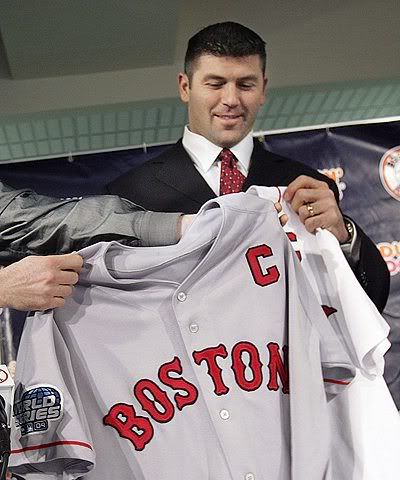
NOTE: I had been contemplating writing about Jason Varitek’s place with the Red Sox for some time now, but his controversial All-Star selection sped up the process for me...
Multiyear contracts for 30+ year old catchers have not been kind to teams throughout history. The list of productive catchers, 35 & older, begins and ends with Carlton Fisk--though Jorge Posada is making a valiant effort to join him. In 2004, the Boston Red Sox signed their then-32 year-old catcher, Jason Varitek, to a 4-year $40 million contract two months after winning their first World Series in 86 years. Varitek was named the captain of the team, only the third Red Sox player to receive the honor since 1923.
The decision to sign Varitek was not as automatic as one might think. To that point, the Epstein regime had been especially opposed to signing aging stars to multiyear contracts regardless of their organizational ties—-especially catchers who are known to have shorter shelf-lives than any other position. The idea being that teams should be paying players for future performance rather than past performance. It's the mindset that sent Cliff Floyd, Pedro Martinez, Johnny Damon, and Derek Lowe looking for work elsewhere at various points throughout Epstein's tenure. But with minimal catching options elsewhere, (rumors of a trade for Brian Schneider surfaced for a while), the Sox were willing to give in to Varitek and agent Scott Boras’s demands.
"It's not every day you're lucky enough to sign a player who embodies everything you want your franchise to be," general manager Theo Epstein said. "When you have that player, you don't let him get away."
Varitek responded with an excellent 2005 season, posting a .281/.366/.489 line in 133 games. The contract was justified for one season, at least. However, as Mets and Yankees fans have witnessed with Pedro Martinez and Johnny Damon, the decline period usually doesn’t surface in year one. It is the later years of the deals where they begin to look bad.
Unfortunately for the Red Sox, Varitek’s decline began even sooner than they had hoped. His injury-plagued 2006 season resembled that of a 34 year old catcher, batting .238/.325/.400. To his credit, the Red Sox’ collapse from contention,just as it did in 2001, coincided with Varitek’s knee injury in August. Varitek bounced back slightly in 2007, recording a respectable .255/.367/.421 season, good for a 103 OPS+. The Red Sox won the World Series for the second time, sweeping the Colorado Rockies. Varitek’s performance behind the plate overshadowed anything he did at the plate.
Now, at age 36 and in the final year of his deal, Varitek is having the worst statistical season of his career. Mired in a 14 for 99 (.141) slump, Varitek is posting splits of .220/.300/.360—numbers that fans once expected from Doug Mirabelli. Oddly enough, he was selected by his peers to represent the American League in the All-Star game for the third time—this in spite of his -2.3 value over replacement player (VORP).
VORP measures the number of runs a player contributes beyond what a replacement-level player at the same position would contribute if he were given the same percentage of a team’s plate appearances. In other words, Varitek’s VORP is the number of runs that he improves the Red Sox offense by, by having him in the lineup instead of an easily attainable replacement-level catcher. In other words part 2, by carrying a negative VORP, you can take just about any available catcher, plug him into Varitek’s place in the Red Sox lineup, and they instantly become a better offensive team.
So where is Varitek’s true value? In some cases, it’s in aspects of the game that can’t be quantified. In other cases, you can quantify it, but to an uncertain degree. This is a very tricky game for front-offices to play: how much credence do you put into intangibles?
For example, in 2001 and 2006, the team ERA and opposing OPS rose considerably when Varitek got injured and catchers like Scott Hatteberg, Doug Mirabelli, and Javy Lopez were calling the shots. Is this a representation of game-calling ability or is it luck? As a Red Sox fan, my gut tells me that it is indicative of Varitek’s talents, but objectively it could be coincidental. There's really no way of knowing.
As an outsider, it’s hard to judge how great of a game-caller Varitek is but the reviews from his peers say a lot. (EDIT: Yes, these are the same peers who were responsible for some outlandish All-Star selections--Varitek included--so maybe their opinions should be taken lightly) Varitek has caught great pitchers like Pedro Martinez, Curt Schilling, and Josh Beckett, who have each raved about Varitek’s preparation and mental fortitude in holding down the pitching staff. Veterans like Hideo Nomo, Bret Saberhagen, Pat Rapp, and David Cone, who bounced around at the end of their careers, each experienced solid post-prime seasons with Varitek at the helm. Young starters for Boston have also found success while working with Varitek. Recently, compare the early results of Jon Lester, Clay Buchholz, and Justin Masterson in a hitter’s ballpark to those of Phil Hughes and Ian Kennedy, two prospects who were generally regarded more highly than Boston's. Would the results be different if the catchers were swapped? I think it's fair to believe that.
One intangible that I don’t buy into, is that his presence has an effect on team chemistry. Unlike basketball and football, where teamwork is so prevelant that chemistry issues constantly surface, baseball is an individual sport masquerading as a team sport. You don’t win baseball games because you have good chemistry. You appear to have good chemistry because you are winning games. The baseball media always perpetuates erroneous beliefs regarding causation and correlation. It’s similar to the fallacy you always hear about Jose Reyes and the New York Mets. “The Mets are a winning team when Jose Reyes is having fun and smiling.” No, that’s not true at all. Jose Reyes is having fun and smiling because the Mets are winning—not the other way around.
So are Varitek’s intangibles overrated? Could another catcher step in and handle the staff as well as he has? Possibly, but without being able to know for sure, and without there being a plethora of alternatives, is replacing Varitek at the end of the season a risk worth taking? I don’t think that it is. Russell Martins and Joe Mauers don’t grow on trees, so there aren't many significant improvements out there. I’d feel much more comfortable with Varitek and his relationship with the staff behind the plate than I would feel if the Sox were to hand the reins over to some unknown commodity in search of 40 points of OPS.
However, the Red Sox can not allow Varitek and his captaincy to become an albatross for the team offensively. If the Red Sox are to resign him—and as long as there aren’t any maniacal offers to match, I think they should (2 years is about where I’d max out...the $ value means little to me since the Red Sox have the money)—they can no longer treat him as an above average offensive player. They must recognize that he is now your ordinary defensive-oriented catcher with some occasional pop.
He should bat 8th or 9th at all times and he should rarely get a 4th at-bat in a game that the Red Sox are trailing. His bat speed is far too slow to catch up with late-inning fireballers. Pinch-hit for him, pinch-run for him, and give him extra days off during the season, along with the mandatory Wakefield rest. If it’s agreed that Varitek’s importance behind the plate is where his true value comes from, then he should not be insulted if and when Francona sends up a better hitter (Sean Casey, Brandon Moss, Alex Cora) in a big spot. Better yet, as the captain, he should be fully supportive, seeing as each of the aforementioned moves would be in the team’s best interest.
Wednesday, June 11, 2008
Is Pretty Boy Floyd Gone For Good?

Well, as you probably know, the best pound for pound fighter in the world today, Floyd Mayweather has officially announced his retirement from boxing. Mayweather's announcement came as a bit of a surprise given that he is currently in the prime of his career and the height of his drawing power. The announcement officially squashes any chance of the September 20th De La Hoya-Mayweather rematch that many would have watched but few would have cared about.
So is he done? Boxers always seem to have trouble staying away from the ring, so the odds are probably in favor of Mayweather lacing up the gloves once again--especially for a guy with the propensity to spend money the way he does. It would be a shame if he doesn't, given the entertainment that Money Mayweather brings to the sport. A fighter with Mayweather's blend of skills and instincts comes along once every few generations. He's also one of the few transcendent personalites boxing has left and losing him will be a devestating blow to the interest of the common fan. And from a selfish standpoint, no Mayweather means no Floyd Mayweather-Miguel Cotto megafight. (Or even a lesser fight against some other established welterweight like Antonio Margarito, Shane Moseley, or Paul Williams)
On the Kellerman and Kenny radio show today (10-1, 1050ESPN, best sports talk radio show in NYC), Max Kellerman concocted a pretty interesting theory regarding Mayweather's retirement:
According to Kellerman, most of Mayweather's persona depends on his brand being a massive draw, almost like how a Mercedes Benz is special because it is a Mercedes Benz. As long as people continue to think of Mayweather as a huge draw, the more he ends up being a huge draw. His first fight with De la Hoya set records; it reached 2.4 million households and generated around $120 million. Floyd earned $25 million from it. However, it wasn't a particularly exciting fight. Fans weren't really clamoring for a rematch. It would have been practically impossible for Mayweather-De La Hoya II to match what the first fight did, numbers-wise.
Now if the rematch happened, and it paled in comparison to the profitably of the first fight, or even worse if he were to somehow lose, Mayweather's brand takes a HUGE hit. It makes him look less important to the public, or less interesting. As a result, Mayweather calls off the fight via this psuedo-retirement and takes 12-18 months off in hopes of building anticipation for a bigger fight that fans are actually interested in.
In the meantime, Miguel Cotto will face Antonio Margarito on July 26th. Assuming Cotto is victorious, he enhances his draw power to make himself a worthy contender for De la Hoya. If he beats De la Hoya, he officially becomes a mega-star and the demand for a fight vs. Mayweather soars through the roof. At that point, Mayweather will demand a huuuuuuuuuge purse and come back to fight Cotto in what will be one of the biggest fights in boxing history. And if Cotto were to lose at any point along the way, then Mayweather can say that Cotto was never deserving of a fight anyway, a convenient excuse given the public perception that Mayweather is ducking Cotto.
Does it make sense? I really think so. Or at the very least, it made sense when Kellerman said it, so if I butchered it, it's my fault.
Tuesday, June 03, 2008
Schilling and Dice-K have some company...
Looks like David Ortiz is going to miss at least a month with tendon sheath damage in his left wrist. My first reaction was that this sounds strikingly similar to Nomar Garciaparra's 2001 injury, which effectively ended his career as an elite hitter.
My gut feeling is that after unsuccessfully trying to let it heal through rehabilitation, Ortiz has the surgery and misses the rest of the season (and postseason). Wrist injuries are the worst, as there's really no telling if a player will ever be the same afterwards. Nomar never returned to form; Derrek Lee is only starting to hit for power again, two years after his wrist injury.
Which then begs the biggest question for the rest of the 2008 season, a season in which the Red Sox are still a championship contender in spite of injuries to countless superstars--Are there any lefthanded, power bats that the Red Sox could acquire cheaply who could slide into the DH/3 hole and produce elite numbers? You know something? I actually think there might be somebody....
My gut feeling is that after unsuccessfully trying to let it heal through rehabilitation, Ortiz has the surgery and misses the rest of the season (and postseason). Wrist injuries are the worst, as there's really no telling if a player will ever be the same afterwards. Nomar never returned to form; Derrek Lee is only starting to hit for power again, two years after his wrist injury.
Which then begs the biggest question for the rest of the 2008 season, a season in which the Red Sox are still a championship contender in spite of injuries to countless superstars--Are there any lefthanded, power bats that the Red Sox could acquire cheaply who could slide into the DH/3 hole and produce elite numbers? You know something? I actually think there might be somebody....
Thursday, April 10, 2008
So Billy Beane and I made the same mistake...
...and didn't trade Rich Harden after getting two great starts out of him to start the season. Harden has been placed on the DL, in one of baseball's annual traditions. As for my fantasy team, I'll replace Harden with Randy Johnson, who is returning from his stint on the DL, Monday against San Francisco. Beane, unfortunately, is in a little more trouble.
Wednesday, April 09, 2008
Season Preview, Part VI
8) Seattle Mariners, 88–74, (1st place in AL West)
The winner of the American League’s weakest division will be the Seattle Mariners. I will admit that I don’t particularly like Seattle as presently constructed—I just feel like the Angels are very susceptible to a down season in 2008.
Last year, the Mariners outperformed their Pythagorean Record by a large enough margin that the acquisition of Eric Bedard will likely just allow them to sustain their 2007 improvement. The leap to division champions comes on the shoulders of Felix Hernandez. King Felix has been around for so long that it’s easy to forget that he’s still just 21 years old. He’s two years younger than Clay Buchholz and Tim Lincecum and the same age as Phil Hughes, yet with 400+ innings of MLB experience under his belt. 2008 will be King Felix’s breakout season. Last year he posted a 3.92 ERA, despite allowing an extremely unlucky .338 batting average on balls in play. (.300 is average for a pitcher) Assuming a natural regression to the mean in BABIP, along with progression as a pitcher growing into his stuff, 2008 will result in a monster season for Hernandez, my pick for AL Cy Young
Seattle’s lineup is extremely weak. Ichiro is the only premier bat, but as a slap singles hitter, he isn’t likely to kill you the way that other superstars can. Adrian Beltre and Raul Ibanez aren’t terrible, but they’d look much better surrounded by an all-star masher. Instead, they are surrounded by Jose Vidro and his 6 home runs as the everyday designated hitter. Man, if only they were able to acquire a designated hitter who could hit 25 home runs, and bat at a .280/.450/.550 clip. I know hitters like that don’t grow on trees, especially ones who enjoy playing on the west coast. And could you imagine the number of prospects you’d have to give up to get a guy like that? Those are practically Albert Pujols-like numbers. Wait, you mean there is somebody available like that? Barry Bonds is still a free agent? And the Seattle Mariners are content with sticking with Jose Vidro at DH? Seriously?
Introducing your 4 divisional series losers….
7) Los Angeles Dodgers, 88–74, (2nd place in NL West, NL Wild Card)
There’s something humorous to me about Joe Torre replacing Grady Little as the Los Angeles Dodgers’ skipper. If Torre didn’t embarrass Little enough in 2003, he certainly finished the job this offseason. The Dodgers began negotiating with Torre while Little still held the position. Little, realizing for the first time in his career that it was time to pull the plug, felt threatened by Torre and chose to resign. If only John Henry and Larry Lucchino had thought to recruit Torre during the 8th inning of the ALCS, baseball history would have been written a lot differently…
Bitterness aside, the Dodgers are better suited with Torre at the helm—considering that they are a playoff contender and all. The one person who’d disagree is Scott Proctor, a reliever reunited with the manager that pitched him over 200 innings in roughly two seasons in New York. Torre’s arrival in Los Angeles is Proctor’s right arm’s worst nightmare. Torre is certainly a change of pace from Little, who might not be aware that relief pitchers actually exist.
Torre might not have to summon Proctor as often as he did in New York, however, because the Dodgers boast the NL’s strongest starting rotation. Brad Penny has established himself as one of the NL’s premier pitchers. Looks like Paul DePodesta knew what he was doing after all. Another widely criticized DePodesta acquisition, Derek Lowe, has revived his career in LA, throwing three straight seasons of sub-4.00 ERA ball. Joining Lowe and Penny is veteran Japanese pitcher, Hiroki Kuroka, a 33 year old right hander who will provide the Dodgers with a season better than Daisuke Matsuzaka’s first year with Boston. If Chad Billingsley makes “The Jump” that management expects, the Dodgers will throw out a front four as good as anyone in the National League. A staff as good as LA’s will be enough for Joe Torre’s consecutive playoff streak, unlike his former team, to continue in 2008.
6) Milwaukee Brewers, 89–73, (1st place in NL Central)
Lost in the media’s love affair with the Chicago Cubs is the best team in the NL Central, the Milwaukee Brewers. In 2007, the Brewers took great strides towards becoming a National League contender, posting an 83-79 record, an eight game improvement on their 2006 total. As a young and improving team, it’s reasonable to expect similar progression in 2008 for the Brew Crew.
First and foremost, the Brewers need a healthy season out of Ben Sheets. Sheets is one of baseball’s most underrated pitchers, the all-time leader in BB/9 for pitchers with a K/9 over 7 and he is 4th all-time in K/BB ratio. However, health is always an issue for Sheets. He hasn’t thrown 200+ innings since 2004 making it tough for Milwaukee to rely on his production. Luckily, Milwaukee finally has some help in the rotation. Yovani Gallardo pitched brilliantly after being called up last season. Gallardo is one of the NL’s brightest young pitchers. Joining them this season is rookie LHP Manny Parra. Parra is a 2001 draft pick whose road to Milwaukee was derailed by injuries. He reestablished himself as a top prospect with a brilliant 2007 season at AA and AAA. After a strong spring training, the Brewers believe Parra is ready to be an integral part of their staff. Jeff Suppan can be expected to provide 200+ league average innings.
Is there a better collection of homegrown talent in baseball than Milwaukee’s? Prince Fielder, Rickie Weeks, J.J. Hardy, and Bill Hall make up the only 100% homegrown infield that I can think of. Corey Hart and 2007 Rookie of the Year, Ryan Braun, manage the corners, bringing the total to six out of the eight everyday players coming from within. With all of this young talent blossoming at the major league level, as you can imagine, there isn’t much left from a positional standpoint. 2007 1st round pick OF Matt LaPorta, a player the Red Sox drafted in 2006 but couldn’t reach terms with, is the last premier positional prospect remaining. He is the classic all-bat, no-glove player but, man, he can rake. In just 115 at-bats after being drafted, LaPorta smashed 12 home runs. At 22 years old, LaPorta will not need much more seasoning at the minor league level. If the Brewers feel Corey Hart can play center field, LaPorta will end up in one of the corners (probably by 2009). Either that, or Bud Selig will find a way to switch the Brewers into the American League so that LaPorta and Fielder can share 1B/DH duties.
The winner of the American League’s weakest division will be the Seattle Mariners. I will admit that I don’t particularly like Seattle as presently constructed—I just feel like the Angels are very susceptible to a down season in 2008.
Last year, the Mariners outperformed their Pythagorean Record by a large enough margin that the acquisition of Eric Bedard will likely just allow them to sustain their 2007 improvement. The leap to division champions comes on the shoulders of Felix Hernandez. King Felix has been around for so long that it’s easy to forget that he’s still just 21 years old. He’s two years younger than Clay Buchholz and Tim Lincecum and the same age as Phil Hughes, yet with 400+ innings of MLB experience under his belt. 2008 will be King Felix’s breakout season. Last year he posted a 3.92 ERA, despite allowing an extremely unlucky .338 batting average on balls in play. (.300 is average for a pitcher) Assuming a natural regression to the mean in BABIP, along with progression as a pitcher growing into his stuff, 2008 will result in a monster season for Hernandez, my pick for AL Cy Young
Seattle’s lineup is extremely weak. Ichiro is the only premier bat, but as a slap singles hitter, he isn’t likely to kill you the way that other superstars can. Adrian Beltre and Raul Ibanez aren’t terrible, but they’d look much better surrounded by an all-star masher. Instead, they are surrounded by Jose Vidro and his 6 home runs as the everyday designated hitter. Man, if only they were able to acquire a designated hitter who could hit 25 home runs, and bat at a .280/.450/.550 clip. I know hitters like that don’t grow on trees, especially ones who enjoy playing on the west coast. And could you imagine the number of prospects you’d have to give up to get a guy like that? Those are practically Albert Pujols-like numbers. Wait, you mean there is somebody available like that? Barry Bonds is still a free agent? And the Seattle Mariners are content with sticking with Jose Vidro at DH? Seriously?
Introducing your 4 divisional series losers….
7) Los Angeles Dodgers, 88–74, (2nd place in NL West, NL Wild Card)
There’s something humorous to me about Joe Torre replacing Grady Little as the Los Angeles Dodgers’ skipper. If Torre didn’t embarrass Little enough in 2003, he certainly finished the job this offseason. The Dodgers began negotiating with Torre while Little still held the position. Little, realizing for the first time in his career that it was time to pull the plug, felt threatened by Torre and chose to resign. If only John Henry and Larry Lucchino had thought to recruit Torre during the 8th inning of the ALCS, baseball history would have been written a lot differently…
Bitterness aside, the Dodgers are better suited with Torre at the helm—considering that they are a playoff contender and all. The one person who’d disagree is Scott Proctor, a reliever reunited with the manager that pitched him over 200 innings in roughly two seasons in New York. Torre’s arrival in Los Angeles is Proctor’s right arm’s worst nightmare. Torre is certainly a change of pace from Little, who might not be aware that relief pitchers actually exist.
Torre might not have to summon Proctor as often as he did in New York, however, because the Dodgers boast the NL’s strongest starting rotation. Brad Penny has established himself as one of the NL’s premier pitchers. Looks like Paul DePodesta knew what he was doing after all. Another widely criticized DePodesta acquisition, Derek Lowe, has revived his career in LA, throwing three straight seasons of sub-4.00 ERA ball. Joining Lowe and Penny is veteran Japanese pitcher, Hiroki Kuroka, a 33 year old right hander who will provide the Dodgers with a season better than Daisuke Matsuzaka’s first year with Boston. If Chad Billingsley makes “The Jump” that management expects, the Dodgers will throw out a front four as good as anyone in the National League. A staff as good as LA’s will be enough for Joe Torre’s consecutive playoff streak, unlike his former team, to continue in 2008.
6) Milwaukee Brewers, 89–73, (1st place in NL Central)
Lost in the media’s love affair with the Chicago Cubs is the best team in the NL Central, the Milwaukee Brewers. In 2007, the Brewers took great strides towards becoming a National League contender, posting an 83-79 record, an eight game improvement on their 2006 total. As a young and improving team, it’s reasonable to expect similar progression in 2008 for the Brew Crew.
First and foremost, the Brewers need a healthy season out of Ben Sheets. Sheets is one of baseball’s most underrated pitchers, the all-time leader in BB/9 for pitchers with a K/9 over 7 and he is 4th all-time in K/BB ratio. However, health is always an issue for Sheets. He hasn’t thrown 200+ innings since 2004 making it tough for Milwaukee to rely on his production. Luckily, Milwaukee finally has some help in the rotation. Yovani Gallardo pitched brilliantly after being called up last season. Gallardo is one of the NL’s brightest young pitchers. Joining them this season is rookie LHP Manny Parra. Parra is a 2001 draft pick whose road to Milwaukee was derailed by injuries. He reestablished himself as a top prospect with a brilliant 2007 season at AA and AAA. After a strong spring training, the Brewers believe Parra is ready to be an integral part of their staff. Jeff Suppan can be expected to provide 200+ league average innings.
Is there a better collection of homegrown talent in baseball than Milwaukee’s? Prince Fielder, Rickie Weeks, J.J. Hardy, and Bill Hall make up the only 100% homegrown infield that I can think of. Corey Hart and 2007 Rookie of the Year, Ryan Braun, manage the corners, bringing the total to six out of the eight everyday players coming from within. With all of this young talent blossoming at the major league level, as you can imagine, there isn’t much left from a positional standpoint. 2007 1st round pick OF Matt LaPorta, a player the Red Sox drafted in 2006 but couldn’t reach terms with, is the last premier positional prospect remaining. He is the classic all-bat, no-glove player but, man, he can rake. In just 115 at-bats after being drafted, LaPorta smashed 12 home runs. At 22 years old, LaPorta will not need much more seasoning at the minor league level. If the Brewers feel Corey Hart can play center field, LaPorta will end up in one of the corners (probably by 2009). Either that, or Bud Selig will find a way to switch the Brewers into the American League so that LaPorta and Fielder can share 1B/DH duties.
Monday, April 07, 2008
Season Preview Part V
12) Toronto Blue Jays, 85–77, (T-3rd place in AL East)
The longer it takes to finish this preview, the more and more likely I’ll second guess my placement of the Toronto Blue Jays. After three very competitive games with the Yankees, the Blue Jays completed a sleep of the defending World Champions earlier today, proving that they belong in the discussion with the AL’s megapowers. The Blue Jays have won between 83 and 88 games each season for the past ten seasons. Stuck in the highly competitive AL East, the Blue Jays have the most victories of any team who has failed to make the playoffs during the Wild Card era. If Bud Selig chooses to implement my aforementioned “Swap a team to the NL” rule change, the Blue Jays would be a perennial NL powerhouse.
In 2008, the Blue Jays have their best all-around team to date. When healthy, their pitching staff, top to bottom, is the league’s best. Staff ace Roy Halladay is arguably the American League’s best starter. Halladay is a throwback to days when the starting pitcher’s objective was to finish the game that he started. Halladay’s is a refreshing act, one that is nearing extinction given today’s era of 6 IP, 3 ER quality starts. Following Halladay is uber-talented righthander A.J. Burnett, a serious breakout candidate given his contractual status. Burnett has an opt-out clause in his deal and he and his agent have indicated that if he pitches well this season, he will execute his right to opt-out and play the open market. When was the last time Burnett made all of his starts in one season, you ask? His last contract season, the year before signing with Toronto. 2008 has career year written all over it. Rounding out the rotation is a trio of high-upside righthanders in Dustin McGowan (the best of the bunch and future Cy Young candidate), Shaun Marcum, and Jesse Litsch, each of whom came on strong towards the end of 2007. Neither the Red Sox, nor the Yankees can feel as comfortable with the back end of their rotation as Toronto does.
The Blue Jays will have no problems scoring either. Vernon Wells is fully recovered from a shoulder injury that zapped away all of his power in 2007. Feeling healthy once again, Wells is poised for a strong bounce back campaign. Alex Rios is an emerging superstar, perhaps the best right fielder in the American League. And if “The Big Hurt”, Frank Thomas can continue swinging his imposing bat (RE: Manny Delcarmen), as he has in the early going, the Jays will pose a very deep lineup that wears down weak opposing pitching staffs.
On the other side of the diamond, the addition of Scott Rolen, (who’s currently on the DL with a broken finger), bolsters an already solid defense. When Rolen finally joins second baseman Aaron Hill (who Peter Gammons declared the best all-around 2B in the AL East) and first baseman Lyle Overbay, and John McDonald is at shortstop, the Blue Jays could have the best defensive infield as well.
So, the question remains… Why third place? I wish I had a better answer. The Blue Jays would probably win half of the other divisions in baseball. Trapped in the AL East, they just need too much to go right for them to be left standing come October. This Blue Jays squad can win 90+ games, but more than likely they’ll endure another strong, but playoff-less season, whose reward will be playing spoiler to the Wild Card hopes of the AL East’s second=place team.
11) Tampa Bay Rays, 85–77, (T-3rd place in AL East)
The Tampa Bay Rays managed to get rid of the most negativity of any team, this offseason. After officially dropping the “Devil” from their team name, the Rays sent troubled outfielder Elijah Dukes to our city’s capital and the disgruntled Delmon Young to the North Star State. The symbolism was evident. These are not your father’s older brother’s Rays.
BaseballProspectus.com’s famous PECOTA forecasting system is predicting 88 wins. While 88 might be a reach, the Rays enter 2008 with a strong chance to post their first winning season in franchise history. At the very least, the Rays will play a huge role in determining the AL East champions. If the Yankees are the Republicans and the Red Sox are the Democrats, the Rays are an Independent party looking to steal votes. The team they steal the most votes from is likely to lose the divisional race, and possibly the wild card as well.
The future is even brighter than the 2008 outlook. The organization is already looking ahead in that regard. Case in point: their decision to start Evan Longoria in AAA in an effort to delay his arbitration/free angency eligibility.
In 2010, the Rays could post the following lineup:
CF Desmond Jennings
LF Carl Crawford
1B Carlos Pena
RF B.J. Upton
3B Evan Longoria
SS Reid Brignac
DH Rocco Baldelli (wouldn’t count on it, but let’s not forget how young he is)
C Dioner Navarro
2B Akinori Iwamura (or Brignac at 2B with 2008’s 1st overall pick at SS)
With this rotation:
Scott Kazmir
David Price
James Shields
Matt Garza
Whoever pans out of Wade Davis, Jeff Niemann, and Jacob McGee
Davis has the best chance of the trio to be a high-quality starter. Niemann would profile well as a reliever, given his size and his injury history. McGee is a lefty with mid to high 90’s heat. He’ll have plenty of opportunities to prove himself. Even if all three fail to pan out, the Rays still have young pitchers like Edwin Jackson and Andrew Sonnanstine to round out the rotation. (Both guys pitched well down the '07 stretch) Still not the worst of options for a #5 starter.
Keeping in mind how unpredictable young players are, there has arguably never been a collection of talent as good as Tampa’s coming together at the exact same time. Most of the talent was assembled through high draft picks thanks in part to the team’s ineptitude. But proper decision making is just as vital, if not more so, when drafting that high. Keep in mind, Pittsburgh has been just as bad for just as long, with much less to show for. The thought seems crazy, but playoff baseball in Tampa Bay is not far away. (To speed up the process, I wonder if Andrew Friedman would vote in my idea to switch to the National League!)
10) New York Yankees, 89-73, (2nd place in AL East)
A few years ago, Major League Baseball implemented an unbalanced schedule to capitalize on the growing interest in divisional rivalries. Divisional adversaries now played 18 or 19 games against each other. The Red Sox and Yankees benefited immensely. After pocketing the huge gates from their 19 wars with each other, both teams were rewarded with 38 games against the floundering Orioles and the atrocious Devil Rays, who have been amongst the league’s worst teams since their inception. However, in light of Toronto and Tampa’s significant improvement, the fun ends this season. The AL East runner-up is no longer guaranteed a playoff spot and as such, the Yankees come into 2008 with a possibility of missing the playoffs for the first time since 1993.
The Yankees enter 2008 in a quasi-rebuilding phase, eerily similar to the 2005 Red Sox, albeit not as defending champions. While much has been made of the Joba Chamberlain/Phil Hughes/Ian Kennedy trio (CHK) and their symbolism of the Yankee paradigm shift towards youth, the Yankees remain an expensive team (baseball’s only $200 million team) with old parts. Melky Cabrera and Robinson Cano are the only regulars under 32 years old. Considering a baseball player’s prime generally exists between ages 27 and 31, it’s possible that the Yankees’ best players’ best seasons are behind them, yet players like Johnny Damon, Jason Giambi, and Hideki Matsui are still being paid like superstars. The presence of their contracts has left the Yankees pot-committed, forcing them to scramble to contend as these former stars exit their primes. It also alters management’s decision making in the short term. For example, the extra years tacked on to the contracts of Jorge Posada and Mariano Rivera this offseason were irrational long-term and likely to be regretted, but they were completely necessary for the Yankees chances to compete in 2008.
But luckily, the end of the madness is in sight. The Yankees have more than $80 million coming off of their payroll in 2008 followed by another $30 million in 2009. The Cold War with Boston appears to have died down (though it’s now likely to spill over into the amateur draft), signaling a birth of a new era for both teams. Brian Cashman has finally been given the authority to build from within. A system that was barren just two seasons ago now ranks amongst the league’s best.
Joining the CHK trio is 2007 first round pick Andrew Brackman, a 6’10’’ right hander from NC State, so potentially dominant that the Yankees drafted and signed him to a major league contract despite knowing that he needed Tommy John surgery. If healthy, Brackman could be the best of the bunch. On the opposite side of the field, the Yankees boast two future all star outfielders, Austin Jackson and Jose Tabata. Jackson could be Bobby Abreu’s replacement in right field as the Yankees move into their new stadium in 2009.
Highlighted by two phenomenal young superstars on the left side of the infield, the New York media perpetuates a misconception that the Mets are in better shape for the future than the Yankees. Nothing could be farther from the truth. Taking nothing away from David Wright (the best player in the NL) and Jose Reyes, but even with the discrepancy in age, neither player has ever had a better season than their Bronx counterpart. Fernando Martinez is the only Mets prospect who would crack the Yankees’ top-10, and even still, he’d fall behind Jackson and Tabata on the depth chart. And forget Chamberlain or Hughes, the Mets don’t have one starting pitcher in Kennedy’s class either.
The Yankees will be better than 5th best in the AL and 9th best in baseball. The best team in New York will likely have the second most wins in New York. In the NL East, the Yankees win the division by five games. However, young pitchers struggle with the quality of lineups in the AL and the Yankees do not have strong enough middle relief to compensate for nights when Hughes or Kennedy doesn’t have it. (For Kennedy, it will be much more often than Yankee fans had hoped. He has NL Central starter written all over him.) It also places inordinate pressure on Chien Ming Wang, an excellent pitcher who is unfairly overslotted as an ace in this staff, and Andy Pettitte to pitch deep into games during every start.
But the lineup will still score runs. Alex Rodriguez remains the game’s best hitter (maybe history’s?), Jeter is Jeter, and my MVP runner up pick, Bobby Abreu is in the best shape of his life, poised for a monster season, as he looks for one last huge contract. Will the offense be enough to push New York to the playoffs? It was last year, but the AL has improved immensely once again. This year, I think the Yankees miss the postseason by a hair. However, as the emergent developmental monster lurks towards the forefront, 2008 might be baseball’s final chance to witness an October without the Evil Empire for quite some time.
12) Los Angeles Angels, 90-72, (2nd place in AL West, AL Wild Card)
One of the worst aspects of laziness is that clicking “save as” can be too much work for me. Unsurprisingly, I lost my lengthy entry on the Angels when my brother closed out my Word document without saving it. As a result, I’ve been too demoralized to try recapturing my prior brilliance (explanation for my hiatus) so I will simply leave you with some bulletpoints to get a sense of where I was heading with the Angels preview.
---Predicting the Angels and Mariners to flip-flop from their place in the 2007 standings isn’t as exciting of an upset pick as, say, predicting San Diego over UConn in a March Madness office pool, but it’s a start. In March Madness, you’ll pick an upset because you’re familiar with a good team who seems susceptible to one, not because you are in love with the 13-seed’s chances. If anybody seems susceptible to falling off, it’s the veteran-laden Angels.
---Calling them the Los Angeles Angels is annoying and confusing.
---Which aging free agent center fielders will the Los Angeles teams overpay for this offseason? 2006 brought in Gary Matthews Jr. and Juan Pierre; 2007 brought Andruw Jones and Torii Hunter. Who will it be in 2008? Rocco Baldelli? Mike Cameron? A return of Jim Edmonds? Tune in and find out!
---Every time the Red Sox win a World Series, they sweep the Angels in the ALDS. A playoff without the Angels could be an ominous sign for Boston’s chances. The opposite could be said for New York’s chances.
The longer it takes to finish this preview, the more and more likely I’ll second guess my placement of the Toronto Blue Jays. After three very competitive games with the Yankees, the Blue Jays completed a sleep of the defending World Champions earlier today, proving that they belong in the discussion with the AL’s megapowers. The Blue Jays have won between 83 and 88 games each season for the past ten seasons. Stuck in the highly competitive AL East, the Blue Jays have the most victories of any team who has failed to make the playoffs during the Wild Card era. If Bud Selig chooses to implement my aforementioned “Swap a team to the NL” rule change, the Blue Jays would be a perennial NL powerhouse.
In 2008, the Blue Jays have their best all-around team to date. When healthy, their pitching staff, top to bottom, is the league’s best. Staff ace Roy Halladay is arguably the American League’s best starter. Halladay is a throwback to days when the starting pitcher’s objective was to finish the game that he started. Halladay’s is a refreshing act, one that is nearing extinction given today’s era of 6 IP, 3 ER quality starts. Following Halladay is uber-talented righthander A.J. Burnett, a serious breakout candidate given his contractual status. Burnett has an opt-out clause in his deal and he and his agent have indicated that if he pitches well this season, he will execute his right to opt-out and play the open market. When was the last time Burnett made all of his starts in one season, you ask? His last contract season, the year before signing with Toronto. 2008 has career year written all over it. Rounding out the rotation is a trio of high-upside righthanders in Dustin McGowan (the best of the bunch and future Cy Young candidate), Shaun Marcum, and Jesse Litsch, each of whom came on strong towards the end of 2007. Neither the Red Sox, nor the Yankees can feel as comfortable with the back end of their rotation as Toronto does.
The Blue Jays will have no problems scoring either. Vernon Wells is fully recovered from a shoulder injury that zapped away all of his power in 2007. Feeling healthy once again, Wells is poised for a strong bounce back campaign. Alex Rios is an emerging superstar, perhaps the best right fielder in the American League. And if “The Big Hurt”, Frank Thomas can continue swinging his imposing bat (RE: Manny Delcarmen), as he has in the early going, the Jays will pose a very deep lineup that wears down weak opposing pitching staffs.
On the other side of the diamond, the addition of Scott Rolen, (who’s currently on the DL with a broken finger), bolsters an already solid defense. When Rolen finally joins second baseman Aaron Hill (who Peter Gammons declared the best all-around 2B in the AL East) and first baseman Lyle Overbay, and John McDonald is at shortstop, the Blue Jays could have the best defensive infield as well.
So, the question remains… Why third place? I wish I had a better answer. The Blue Jays would probably win half of the other divisions in baseball. Trapped in the AL East, they just need too much to go right for them to be left standing come October. This Blue Jays squad can win 90+ games, but more than likely they’ll endure another strong, but playoff-less season, whose reward will be playing spoiler to the Wild Card hopes of the AL East’s second=place team.
11) Tampa Bay Rays, 85–77, (T-3rd place in AL East)
The Tampa Bay Rays managed to get rid of the most negativity of any team, this offseason. After officially dropping the “Devil” from their team name, the Rays sent troubled outfielder Elijah Dukes to our city’s capital and the disgruntled Delmon Young to the North Star State. The symbolism was evident. These are not your father’s older brother’s Rays.
BaseballProspectus.com’s famous PECOTA forecasting system is predicting 88 wins. While 88 might be a reach, the Rays enter 2008 with a strong chance to post their first winning season in franchise history. At the very least, the Rays will play a huge role in determining the AL East champions. If the Yankees are the Republicans and the Red Sox are the Democrats, the Rays are an Independent party looking to steal votes. The team they steal the most votes from is likely to lose the divisional race, and possibly the wild card as well.
The future is even brighter than the 2008 outlook. The organization is already looking ahead in that regard. Case in point: their decision to start Evan Longoria in AAA in an effort to delay his arbitration/free angency eligibility.
In 2010, the Rays could post the following lineup:
CF Desmond Jennings
LF Carl Crawford
1B Carlos Pena
RF B.J. Upton
3B Evan Longoria
SS Reid Brignac
DH Rocco Baldelli (wouldn’t count on it, but let’s not forget how young he is)
C Dioner Navarro
2B Akinori Iwamura (or Brignac at 2B with 2008’s 1st overall pick at SS)
With this rotation:
Scott Kazmir
David Price
James Shields
Matt Garza
Whoever pans out of Wade Davis, Jeff Niemann, and Jacob McGee
Davis has the best chance of the trio to be a high-quality starter. Niemann would profile well as a reliever, given his size and his injury history. McGee is a lefty with mid to high 90’s heat. He’ll have plenty of opportunities to prove himself. Even if all three fail to pan out, the Rays still have young pitchers like Edwin Jackson and Andrew Sonnanstine to round out the rotation. (Both guys pitched well down the '07 stretch) Still not the worst of options for a #5 starter.
Keeping in mind how unpredictable young players are, there has arguably never been a collection of talent as good as Tampa’s coming together at the exact same time. Most of the talent was assembled through high draft picks thanks in part to the team’s ineptitude. But proper decision making is just as vital, if not more so, when drafting that high. Keep in mind, Pittsburgh has been just as bad for just as long, with much less to show for. The thought seems crazy, but playoff baseball in Tampa Bay is not far away. (To speed up the process, I wonder if Andrew Friedman would vote in my idea to switch to the National League!)
10) New York Yankees, 89-73, (2nd place in AL East)
A few years ago, Major League Baseball implemented an unbalanced schedule to capitalize on the growing interest in divisional rivalries. Divisional adversaries now played 18 or 19 games against each other. The Red Sox and Yankees benefited immensely. After pocketing the huge gates from their 19 wars with each other, both teams were rewarded with 38 games against the floundering Orioles and the atrocious Devil Rays, who have been amongst the league’s worst teams since their inception. However, in light of Toronto and Tampa’s significant improvement, the fun ends this season. The AL East runner-up is no longer guaranteed a playoff spot and as such, the Yankees come into 2008 with a possibility of missing the playoffs for the first time since 1993.
The Yankees enter 2008 in a quasi-rebuilding phase, eerily similar to the 2005 Red Sox, albeit not as defending champions. While much has been made of the Joba Chamberlain/Phil Hughes/Ian Kennedy trio (CHK) and their symbolism of the Yankee paradigm shift towards youth, the Yankees remain an expensive team (baseball’s only $200 million team) with old parts. Melky Cabrera and Robinson Cano are the only regulars under 32 years old. Considering a baseball player’s prime generally exists between ages 27 and 31, it’s possible that the Yankees’ best players’ best seasons are behind them, yet players like Johnny Damon, Jason Giambi, and Hideki Matsui are still being paid like superstars. The presence of their contracts has left the Yankees pot-committed, forcing them to scramble to contend as these former stars exit their primes. It also alters management’s decision making in the short term. For example, the extra years tacked on to the contracts of Jorge Posada and Mariano Rivera this offseason were irrational long-term and likely to be regretted, but they were completely necessary for the Yankees chances to compete in 2008.
But luckily, the end of the madness is in sight. The Yankees have more than $80 million coming off of their payroll in 2008 followed by another $30 million in 2009. The Cold War with Boston appears to have died down (though it’s now likely to spill over into the amateur draft), signaling a birth of a new era for both teams. Brian Cashman has finally been given the authority to build from within. A system that was barren just two seasons ago now ranks amongst the league’s best.
Joining the CHK trio is 2007 first round pick Andrew Brackman, a 6’10’’ right hander from NC State, so potentially dominant that the Yankees drafted and signed him to a major league contract despite knowing that he needed Tommy John surgery. If healthy, Brackman could be the best of the bunch. On the opposite side of the field, the Yankees boast two future all star outfielders, Austin Jackson and Jose Tabata. Jackson could be Bobby Abreu’s replacement in right field as the Yankees move into their new stadium in 2009.
Highlighted by two phenomenal young superstars on the left side of the infield, the New York media perpetuates a misconception that the Mets are in better shape for the future than the Yankees. Nothing could be farther from the truth. Taking nothing away from David Wright (the best player in the NL) and Jose Reyes, but even with the discrepancy in age, neither player has ever had a better season than their Bronx counterpart. Fernando Martinez is the only Mets prospect who would crack the Yankees’ top-10, and even still, he’d fall behind Jackson and Tabata on the depth chart. And forget Chamberlain or Hughes, the Mets don’t have one starting pitcher in Kennedy’s class either.
The Yankees will be better than 5th best in the AL and 9th best in baseball. The best team in New York will likely have the second most wins in New York. In the NL East, the Yankees win the division by five games. However, young pitchers struggle with the quality of lineups in the AL and the Yankees do not have strong enough middle relief to compensate for nights when Hughes or Kennedy doesn’t have it. (For Kennedy, it will be much more often than Yankee fans had hoped. He has NL Central starter written all over him.) It also places inordinate pressure on Chien Ming Wang, an excellent pitcher who is unfairly overslotted as an ace in this staff, and Andy Pettitte to pitch deep into games during every start.
But the lineup will still score runs. Alex Rodriguez remains the game’s best hitter (maybe history’s?), Jeter is Jeter, and my MVP runner up pick, Bobby Abreu is in the best shape of his life, poised for a monster season, as he looks for one last huge contract. Will the offense be enough to push New York to the playoffs? It was last year, but the AL has improved immensely once again. This year, I think the Yankees miss the postseason by a hair. However, as the emergent developmental monster lurks towards the forefront, 2008 might be baseball’s final chance to witness an October without the Evil Empire for quite some time.
12) Los Angeles Angels, 90-72, (2nd place in AL West, AL Wild Card)
One of the worst aspects of laziness is that clicking “save as” can be too much work for me. Unsurprisingly, I lost my lengthy entry on the Angels when my brother closed out my Word document without saving it. As a result, I’ve been too demoralized to try recapturing my prior brilliance (explanation for my hiatus) so I will simply leave you with some bulletpoints to get a sense of where I was heading with the Angels preview.
---Predicting the Angels and Mariners to flip-flop from their place in the 2007 standings isn’t as exciting of an upset pick as, say, predicting San Diego over UConn in a March Madness office pool, but it’s a start. In March Madness, you’ll pick an upset because you’re familiar with a good team who seems susceptible to one, not because you are in love with the 13-seed’s chances. If anybody seems susceptible to falling off, it’s the veteran-laden Angels.
---Calling them the Los Angeles Angels is annoying and confusing.
---Which aging free agent center fielders will the Los Angeles teams overpay for this offseason? 2006 brought in Gary Matthews Jr. and Juan Pierre; 2007 brought Andruw Jones and Torii Hunter. Who will it be in 2008? Rocco Baldelli? Mike Cameron? A return of Jim Edmonds? Tune in and find out!
---Every time the Red Sox win a World Series, they sweep the Angels in the ALDS. A playoff without the Angels could be an ominous sign for Boston’s chances. The opposite could be said for New York’s chances.
Friday, April 04, 2008
2008 Individual Award Predictions
I was planning on posting these at the end of the preview, but the preview is taking much longer than I expected so I want to put these on record before everyone starts thinking I'm letting the early games influence my picks. Leave your picks in the comments section!
AL MVP:
1. Manny Ramirez
2. Bobby Abreu
3. Miguel Cabrera
NL MVP:
1. David Wright
2. Prince Fielder
3. Chase Utley
AL Cy Young:
1. Felix Hernandez
2. Scott Kazmir
3. Daisuke Matsuzaka
NL Cy Young:
1. Johan Santana
2. Jake Peavy
3. Cole Hamels
AL Rookie of the Year:
1. Joba Chamberlain
2. Evan Longoria
3. Clay Buchholz
NL Rookie of the Year:
1. Johnny Cueto
2. Jay Bruce
3. Hiroki Kiroda
AL Manager of the Year:
Joe Maddon
NL Manager of the Year:
Ned Yost
AL MVP:
1. Manny Ramirez
2. Bobby Abreu
3. Miguel Cabrera
NL MVP:
1. David Wright
2. Prince Fielder
3. Chase Utley
AL Cy Young:
1. Felix Hernandez
2. Scott Kazmir
3. Daisuke Matsuzaka
NL Cy Young:
1. Johan Santana
2. Jake Peavy
3. Cole Hamels
AL Rookie of the Year:
1. Joba Chamberlain
2. Evan Longoria
3. Clay Buchholz
NL Rookie of the Year:
1. Johnny Cueto
2. Jay Bruce
3. Hiroki Kiroda
AL Manager of the Year:
Joe Maddon
NL Manager of the Year:
Ned Yost
Season Preview, Part IV
Part IV will be slightly smaller than usual, as I am choosing to break the remaining non-playoff teams into two parts. Part V will be the remaining non-playoff teams and Parts VI and VII will be the playoff teams.
15) Philadelphia Phillies, 85-77, (3rd place in NL East)
So Jimmy Rollins wasn’t crazy after all. After declaring the Philadelphia Phillies “the NL East’s team to beat” last year during spring training, Rollins led the Phillies on a historic September run, coming back from seven games out with 17 to play, to storm past the New York Mets and capture the division title. As a result, Rollins was rewarded with a controversial NL MVP (the award belonged to David Wright or Matt Holliday), along with his first Gold Glove and Silver Slugger award. An even greater performance from Rollins will be necessary in 2008 if the Phillies wish to reach the postseason again.
Last year’s magical run has skewed opinions on this year’s team. Their lineup is still elite. ¾ of their infield are homegrown MVP candidates. The game’s best second baseman, Chase Utley could become Philadelphia’s third straight MVP. (Ryan Howard in 2006, Rollins in 2007)
But discussion of Philadelphia’s lineup, swagger, and clutch ability has taken the focus off of their severe lack of pitching depth. After a spectacular 2007 season, Cy Young candidate Cole Hamels is the only reliable starting pitcher—and that’s assuming he stays healthy. Former ace, Brett Myers is making a return to the rotation after a brief stint as closer last year. There’s no telling if he’ll be able to return to a 200+ IP workload effectively. And the question marks run deeper than Myers. Can Kyle Kendrick and his abysmal 3.7 K/9 rate sustain his performance without striking anybody out? Baseball history says otherwise. Jamie Moyer has gotten a year older. While he won 14 games last season, his ERA was over 5.00. Ironically, if Adam Eaton pitches as “well” as Moyer did last year, he will have knocked a full run off his 2007 6.29 ERA.
The bullpen has just as many questions. Many pundits feel newly acquired closer Brad Lidge has not been the same pitcher since giving up a game-winning home run to Albert Pujols in the 2005 NLCS. Lidge will be starting the season on the DL, but when he returns, it will be interesting to see how he reacts to his first blown save. The Phillies are also missing a shutdown setup man to bridge the gap the Lidge. With starting pitchers who aren’t likely to throw deep into games, the Phillies are likely to lose many ballgames in the later innings. Now taking their torrid September out of the equation, is this a team that you’d trust matching up against improved Atlanta and New York teams? Me neither.
14) Colorado Rockies, 85-77, (3rd Place in NL West)
If the Philadelphia Phillies’ had a torrid September, the Colorado Rockies’ September can only be defined by whatever combination of torrid, scorching, sweltering, and any other word that defines hot you can think of. The Colorado Rockies won 13 of their final 14 regular season games to pull into a tie with the San Diego Padres for the Wild Card. The Rockies followed that up by defeating San Diego in a one-game playoff and sweeping Philadelphia and Arizona in the playoffs, en route to becoming the 2008 National League Champions. The clock didn’t strike twelve for Colorado until Josh Beckett took the mound at Fenway Park and pitched the Red Sox to the first of four straight World Series victories.
In what’s becoming a common theme, teams that finished the season strongly, or needed a borderline miracle run to make the playoffs, end up overrated the following season because fans expect them to build on the previous season’s performance. Instead, they are more likely to regress, as a full season’s worth of games is more indicative of a team’s true ability than one hot stretch at the end of a season. There’s an old saying: “You’re never as bad as your worst game and you’re never as good as your best game.” This holds true with Colorado and Philadelphia. If Trevor Hoffman never blew that horrendous save against Milwaukee at the end of the season, Colorado would have never made the playoffs, and their 2008 outlook would not be as positive. If the Mets hadn’t completely collapsed down the stretch, the same would be said for the Phillies. Look for both teams to endure similar fates in 2008.
13) Atlanta Braves, 86–76, (2nd Place in NL East)
Flipping through the New York Post and reading the daily bickering between superstars like Jimmy Rollins and Carlos Beltran, you would think the NL East was a two team division. And while nobody would blame you for forgetting about the Florida Marlins and the Washington Nationals, there’s a team in Atlanta that is undeservedly flying under the radar in the NL East divisional race. The Braves are relishing being overlooked. For too long, the expectations of a deep October run took its toll on Bobby Cox’s club. Most fans view those Braves as failures, despite their run of consecutive divisional titles, for being a team who didn’t capitalize in the big moment except once, winning the World Series in 1995—to some extent, baseball’s Buffalo Bills. But armed with arguably the best lineup in the National League, the Braves are bracing themselves for a serious run at contention in 2008, albeit with a different style than they used during their 90’s reign.
You’d be hard-pressed to find a lineup in the National League better than Atlanta’s. Chipper Jones is still slugging away in the middle of the order, coming off a season in which he tallied the second highest OPS of his illustrious career. Chipper misses his share of games each season, but his production has shown no sign of slowing down. The Braves will also receive a full season of switch-hitting first baseman Mark Teixeira. Jones and Teixeira could give the Braves the best middle of the order, switch-hitting duo in MLB history. SS Yunel Escobar and RF Jeff Francoeur are primed to join the elite at their respective positions while Brian McCann already provides top of the line production behind the plate. Besides the pitcher’s spot in the order, there is no easy out in Atlanta’s lineup.
The Braves have been the media’s sexy upset pick in 2008. ESPN.com’s Peter Gammons and Jayson Stark, along with Ken Rosenthal of Fox Sports, are each predicting the Braves to appear in their first World Series since 1999. Gammons and Rosenthal have the Braves losing to the Indians in the World Series while Stark has them victorious over the Detroit Tigers. My hesitation in picking them for the playoffs lies within their pitching staff, ironically the one aspect of their team that had been most dependable throughout the last decade.
12) Chicago Cubs, 87-75, (2nd place in NL Central)
One of my least favorite aspects of the start of a new season is the annual “Chicago Cubs to win World Series” column. Every year, a handful of writers hop aboard the Cubbies’ bandwagon for reasons ranging from “their fans deserve it” to “it would be good for the sport to see them win”. Rarely, if ever, does their reasoning involve baseball. This year, only two of ESPN.com’s nineteen experts picked the Cubs to win the World Series, which appears slightly less than usual. But after adding in the fact that 17 of the 19 picked the Cubs to win the NL Central, the media’s “wishful thinking” quotient is right in line with its normal rate.
The Cubs' big addition this offseason was Japanese OF Kosuke Fukodome. Fukodome has been described as a Bobby Abreu-type. He brings a solid left-handed bat and a very good eye to an overly right-handed team that swings at everything. Ideally, Fukodome should bat 1st or 2nd, in front of Derrek Lee, Aramis Ramirez, and Alfonso Soriano. However, Soriano's stubborn insistence to bat leadoff will ultimately leave Fukodome batting lower in the order, getting on base for guys who can’t knock him in.
It isn’t that the 2008 Cubs are a bad team. They’re likely to be finish as one of the top five or six teams in the entire National League. It’s just that the media’s growing love affair with them every season is not only absurd, it is borderline gimmicky—and gimmicks grow old quickly. Just because the Red Sox and White Sox recently extinguished lengthy championship droughts does not mean that the Cubs are suddenly entitled to as well. For those who feel like I do, fear not: It won’t happen this season either.
15) Philadelphia Phillies, 85-77, (3rd place in NL East)
So Jimmy Rollins wasn’t crazy after all. After declaring the Philadelphia Phillies “the NL East’s team to beat” last year during spring training, Rollins led the Phillies on a historic September run, coming back from seven games out with 17 to play, to storm past the New York Mets and capture the division title. As a result, Rollins was rewarded with a controversial NL MVP (the award belonged to David Wright or Matt Holliday), along with his first Gold Glove and Silver Slugger award. An even greater performance from Rollins will be necessary in 2008 if the Phillies wish to reach the postseason again.
Last year’s magical run has skewed opinions on this year’s team. Their lineup is still elite. ¾ of their infield are homegrown MVP candidates. The game’s best second baseman, Chase Utley could become Philadelphia’s third straight MVP. (Ryan Howard in 2006, Rollins in 2007)
But discussion of Philadelphia’s lineup, swagger, and clutch ability has taken the focus off of their severe lack of pitching depth. After a spectacular 2007 season, Cy Young candidate Cole Hamels is the only reliable starting pitcher—and that’s assuming he stays healthy. Former ace, Brett Myers is making a return to the rotation after a brief stint as closer last year. There’s no telling if he’ll be able to return to a 200+ IP workload effectively. And the question marks run deeper than Myers. Can Kyle Kendrick and his abysmal 3.7 K/9 rate sustain his performance without striking anybody out? Baseball history says otherwise. Jamie Moyer has gotten a year older. While he won 14 games last season, his ERA was over 5.00. Ironically, if Adam Eaton pitches as “well” as Moyer did last year, he will have knocked a full run off his 2007 6.29 ERA.
The bullpen has just as many questions. Many pundits feel newly acquired closer Brad Lidge has not been the same pitcher since giving up a game-winning home run to Albert Pujols in the 2005 NLCS. Lidge will be starting the season on the DL, but when he returns, it will be interesting to see how he reacts to his first blown save. The Phillies are also missing a shutdown setup man to bridge the gap the Lidge. With starting pitchers who aren’t likely to throw deep into games, the Phillies are likely to lose many ballgames in the later innings. Now taking their torrid September out of the equation, is this a team that you’d trust matching up against improved Atlanta and New York teams? Me neither.
14) Colorado Rockies, 85-77, (3rd Place in NL West)
If the Philadelphia Phillies’ had a torrid September, the Colorado Rockies’ September can only be defined by whatever combination of torrid, scorching, sweltering, and any other word that defines hot you can think of. The Colorado Rockies won 13 of their final 14 regular season games to pull into a tie with the San Diego Padres for the Wild Card. The Rockies followed that up by defeating San Diego in a one-game playoff and sweeping Philadelphia and Arizona in the playoffs, en route to becoming the 2008 National League Champions. The clock didn’t strike twelve for Colorado until Josh Beckett took the mound at Fenway Park and pitched the Red Sox to the first of four straight World Series victories.
In what’s becoming a common theme, teams that finished the season strongly, or needed a borderline miracle run to make the playoffs, end up overrated the following season because fans expect them to build on the previous season’s performance. Instead, they are more likely to regress, as a full season’s worth of games is more indicative of a team’s true ability than one hot stretch at the end of a season. There’s an old saying: “You’re never as bad as your worst game and you’re never as good as your best game.” This holds true with Colorado and Philadelphia. If Trevor Hoffman never blew that horrendous save against Milwaukee at the end of the season, Colorado would have never made the playoffs, and their 2008 outlook would not be as positive. If the Mets hadn’t completely collapsed down the stretch, the same would be said for the Phillies. Look for both teams to endure similar fates in 2008.
13) Atlanta Braves, 86–76, (2nd Place in NL East)
Flipping through the New York Post and reading the daily bickering between superstars like Jimmy Rollins and Carlos Beltran, you would think the NL East was a two team division. And while nobody would blame you for forgetting about the Florida Marlins and the Washington Nationals, there’s a team in Atlanta that is undeservedly flying under the radar in the NL East divisional race. The Braves are relishing being overlooked. For too long, the expectations of a deep October run took its toll on Bobby Cox’s club. Most fans view those Braves as failures, despite their run of consecutive divisional titles, for being a team who didn’t capitalize in the big moment except once, winning the World Series in 1995—to some extent, baseball’s Buffalo Bills. But armed with arguably the best lineup in the National League, the Braves are bracing themselves for a serious run at contention in 2008, albeit with a different style than they used during their 90’s reign.
You’d be hard-pressed to find a lineup in the National League better than Atlanta’s. Chipper Jones is still slugging away in the middle of the order, coming off a season in which he tallied the second highest OPS of his illustrious career. Chipper misses his share of games each season, but his production has shown no sign of slowing down. The Braves will also receive a full season of switch-hitting first baseman Mark Teixeira. Jones and Teixeira could give the Braves the best middle of the order, switch-hitting duo in MLB history. SS Yunel Escobar and RF Jeff Francoeur are primed to join the elite at their respective positions while Brian McCann already provides top of the line production behind the plate. Besides the pitcher’s spot in the order, there is no easy out in Atlanta’s lineup.
The Braves have been the media’s sexy upset pick in 2008. ESPN.com’s Peter Gammons and Jayson Stark, along with Ken Rosenthal of Fox Sports, are each predicting the Braves to appear in their first World Series since 1999. Gammons and Rosenthal have the Braves losing to the Indians in the World Series while Stark has them victorious over the Detroit Tigers. My hesitation in picking them for the playoffs lies within their pitching staff, ironically the one aspect of their team that had been most dependable throughout the last decade.
12) Chicago Cubs, 87-75, (2nd place in NL Central)
One of my least favorite aspects of the start of a new season is the annual “Chicago Cubs to win World Series” column. Every year, a handful of writers hop aboard the Cubbies’ bandwagon for reasons ranging from “their fans deserve it” to “it would be good for the sport to see them win”. Rarely, if ever, does their reasoning involve baseball. This year, only two of ESPN.com’s nineteen experts picked the Cubs to win the World Series, which appears slightly less than usual. But after adding in the fact that 17 of the 19 picked the Cubs to win the NL Central, the media’s “wishful thinking” quotient is right in line with its normal rate.
The Cubs' big addition this offseason was Japanese OF Kosuke Fukodome. Fukodome has been described as a Bobby Abreu-type. He brings a solid left-handed bat and a very good eye to an overly right-handed team that swings at everything. Ideally, Fukodome should bat 1st or 2nd, in front of Derrek Lee, Aramis Ramirez, and Alfonso Soriano. However, Soriano's stubborn insistence to bat leadoff will ultimately leave Fukodome batting lower in the order, getting on base for guys who can’t knock him in.
It isn’t that the 2008 Cubs are a bad team. They’re likely to be finish as one of the top five or six teams in the entire National League. It’s just that the media’s growing love affair with them every season is not only absurd, it is borderline gimmicky—and gimmicks grow old quickly. Just because the Red Sox and White Sox recently extinguished lengthy championship droughts does not mean that the Cubs are suddenly entitled to as well. For those who feel like I do, fear not: It won’t happen this season either.
Thursday, April 03, 2008
Season Preview, Part III
20) Texas Rangers, 75 – 87, (3rd place in AL West)
Whenever I make season predictions, there’s always a random team who sneaks up the chart farther than I expected. This year it’s the Texas Rangers. It’s not that they have gotten particularly better. It’s just that other teams (Oakland, Minnesota, etc.) have regressed a little more.
Last season, the Rangers made a decision to replenish the farm system, trading All-Star 1st baseman Mark Teixeira to Atlanta for the Braves’ three best prospects. (C Jarrod Saltalamacchia, SS Elvis Andrus, and SP Matt Harrison) Saltalamacchia was the game’s best catching prospect before Matt Weiters got drafted. Andrus is a talented 19-year old shortstop of the ‘Jose Reyes’ mold, who scouts have been raving about since Atlanta signed him as a 16-year old. Harrison is a 22-year old lefthander who has had solid minor league statistics at every point along the way. Although management was slammed for the trade, the deal made a lot of sense for the Rangers. Management had finally committed to righting the ship. Their alternative would have been signing Teixeira to a big money, long-term extension. If they had chosen to go that route, the Rangers would have languished in 70-winville with no signs of getting out anytime soon. Now, they at least have a sense of direction.
The Rangers followed the Teixeira trade with two clever deadline deals. One deal sent Kenny Lofton to the Indians for C Max Ramirez. The other sent Eric Gagne to Boston for three solid prospects, Kason Gabbard, David Murphy, and Engel Beltre. Gabbard and Murphy are already capable of contributing in the majors and the 18-year old, Beltre is a high-upside five-tool prospect out of the Dominican Republic who has been compared to everyone from Barry Bonds to Alfonso Soriano.
>>Tangent- In those trades, the Rangers pulled off one of my favorite, but underutilized low-market team trade tactics: Signing veterans to low-money, one-year deals, in seasons where you are not going to compete, and trading them to contenders at the trade deadline. Every season, contenders are looking for an extra arm or bat down the stretch. Operating like this is a very low risk technique to replenish your farm system and I don’t understand why more teams refuse to take advantage of it. End Tangent.<<
The Rangers will continue looking towards the future in 2008. If somebody is willing to take Michael Young’s contract, they’ll explore it—-same goes for Hank Blalock. In the offseason, they acquired OF Josh Hamilton for a highly touted pitching prospect, Edinson Volquez. By now everyone knows Hamilton’s story. Hamilton’s talent is limitless. He has the rare type of ability where if he stays of the field, anything is possible. In 2007, he was baseball’s feel-good story. In 2008, he’s back to being a baseball player; the middle of the order bat that will lead the new era of Rangers into the future.
19) Chicago White Sox, 81 – 81, (3rd place in AL Central)
Nothing screams ‘bland team’ more than an 81-81 prediction. From a forecasting standpoint, it’s really a copout. I’m not saying they’re going to be a winner; I’m not saying they’re going to be a loser. They’re the guy who doesn’t get pinned in a triple threat match.
These White Sox are caught in the same predicament as their ’05 World Series adversaries. They are stuck in “No Man’s Land”. Like the Astros, Kenny Williams still believes he has a championship-caliber nucleus. If just three years ago guys like Paul Konerko, Jose Contreras, and Jermaine Dye, amongst others, could be integral elements of a World Series champion, why couldn’t that still be the case today? Naturally, it is an age issue. The vets are reaching ages where sharp declines in performance are to be expected. (See Konerko, Contreras, and Dye’s 2007) But since these veterans are locked into expensive long-term contracts, it forces Williams to keep building on in hopes of a bounceback, through acquisitions of players like Nick Swisher (Expect a huge season!) and Orlando Cabrera (Expect a huge decline!), even though the likelihood of a playoff run isn’t there.
Like the 2004 Red Sox and 2006 Cardinals, the White Sox won the World Series with a very veteran-laden team. Veteran-laden teams are the least likely to build perennial winners because of inevitable performance declines. Plus, in the aftermath of a championship, emotional attachments often affect decision making, making it hard to part ways with popular “winning” players. Unlike Theo Epstein’s handling of the 2004 Red Sox, Williams was fooled by the 2005 playoffs into overrating his team’s chances of competing again in 2006. They became buyers instead of sellers. Not helping matters is the fact that Williams is a believer of old school baseball mantra: Gritty, gutsy veteran players can drive a team to a championship on sheer perseverance. In 2005, the White Sox caught a perfect storm of timely hitting and extremely hot pitching—not because Konerko, Contreras, and Dye are particularly made for October baseball, but because that specific October, they played well enough to become champions. While fans will never forget that championship run, it will ultimately postpone the franchise’s return to success.
18) San Diego Padres, 83–79, (4th place in NL West)
With seventeen teams remaining, we have reached the point where every team left has a realistic shot to make the playoffs. For all the complaints about competitive balance in baseball, this is essentially the same ratio heading into the season as the NFL.
The NL West is going to be baseball’s tightest division. Aside from the pitiable San Francisco Giants, each team could either win the division or finish in 4th place. It’s that close. This season the Padres are the most likely of the bunch to regress. Their lineup has gotten very old, very quickly. Jim Edmonds and Brian Giles would have made a great outfield six or seven years ago. Aside from Adrian Gonzalez, there aren’t any bats that will strike fear into opposing pitchers. Khalil Greene hit 27 home runs last year, but his pitiful .292 obp takes away any positive thoughts about his bat.
Luckily, the Padres realize that they are not going to win baseball games by outslugging their opponents. Kevin Towers has done an excellent job picking up building a staff that thrives in the Petco Park confines. Jake Peavy is the reigning Cy Young winner and Chris Young was an All-Star experiencing a breakout year before an injury derailed his 2007 campaign. When pitching at Petco, there might not be a better duo in the league. Amazingly, Greg Maddux is still an effective third starter. After that, the Padres have some trouble. While Randy Wolf still has a strong K/9 rate, he’s not the type of starter that a playoff team would depend on. They took a smart low-risk chance on Mark Prior but at this point, only an extreme optimist could envision him contributing again. If Prior can come back effectively, it will bump the Padres up a few games, possibly putting them right back into the divisional picture. I’m just not counting on that.
17) Cincinnati Reds, 84–78, (3rd place in NL Central)
The Cincinnati Reds are my 2008 sleeper team. They are a team with great high-end prospects in Jay Bruce, Joey Votto, Homer Bailey, and Johnny Cueto. Throw in starter Edinson Volquez, acquired from Texas for Josh Hamilton, and it’s easy to see why Baseball America lists Cincy with the third best farm system, behind Tampa Bay and Boston.
The Reds have plenty of talent at the Major League level as well. Adam Dunn is a consistent 40-HR threat in left field and Brandon Phillips has emerged as one of the game’s elite second basemen. The Reds have an impressive one-two combo at the top of their rotation in Aaron Harang and Bronson Arroyo and youngster Johnny Cueto could become the best of the bunch. The 22-year old righthander is already drawing comparisons to Pedro Martinez, throwing a 98 mph heater with a devastating changeup. (EDIT: In his first start, Cueto one-hit the NL West champion Arizona Diamondbacks) The Reds also solidified their bullpen by signing closer Francisco Cordero to a 4-year deal.
If I had any idea what Dusty Baker was thinking, I’d feel much more confident adding a few wins to their total. For now, thoughts of Baker’s managerial style are holding me back. Baker has been reluctant throughout his career to rely on rookies in his everyday lineup. Bruce, baseball’s top prospect, has already been sent to AAA, while Votto is left sharing at bats with Scott Hatteberg at first base. Also, during his tenure with Chicago, Baker’s usage of Kerry Wood and Mark Prior were classic examples of how NOT to manage talented young arms. Is this really the right manager for a team whose future relies heavily on Cueto, Bailey, and Volquez’s right arms? You tell me.
16) Detroit Tigers, 84–78, (2nd place in AL Central, )
---I don’t understand the rationale of building an offensive juggernaut in a pitcher’s ballpark. Wouldn’t that negate any positive effect of a strong lineup?
---They are way too trendy of a pick.
---Pudge Rodriguez sucks, Edgar Renteria will always be a bum, Magglio Ordonez can’t possibly replicate his 2007 season, and Placido Polanco’s not nearly as good defensively as his 0 errors in 2007 would lead you to believe
---Carlos Guillen can rake. He’ll be even better having moved off of shortstop.
---Missing Curtis Granderson is going to kill them. In 2007, Granderson moved himself into Grady Sizemore’s class of elite CF.
---I am not sold on their pitching staff. Justin Verlander has been extremely overworked in his first two seasons that he’s likely to experience some regression this year. Jeremy Bonderman is not what he’s cranked up to be. Kenny Rogers is older than Jesus. Dontrelle Willis is probably going to continue on the downward spiral that his career has been on. They do not have a strong bullpen. Todd Jones should not be closing for a contender. Zumaya and Rodney are still hurt. It’s really not a good staff. Is it manageable if Detroit scores? Sure, and for that reason I expect them to compete. They just won’t make the playoffs.
Part IV tomorrow
Whenever I make season predictions, there’s always a random team who sneaks up the chart farther than I expected. This year it’s the Texas Rangers. It’s not that they have gotten particularly better. It’s just that other teams (Oakland, Minnesota, etc.) have regressed a little more.
Last season, the Rangers made a decision to replenish the farm system, trading All-Star 1st baseman Mark Teixeira to Atlanta for the Braves’ three best prospects. (C Jarrod Saltalamacchia, SS Elvis Andrus, and SP Matt Harrison) Saltalamacchia was the game’s best catching prospect before Matt Weiters got drafted. Andrus is a talented 19-year old shortstop of the ‘Jose Reyes’ mold, who scouts have been raving about since Atlanta signed him as a 16-year old. Harrison is a 22-year old lefthander who has had solid minor league statistics at every point along the way. Although management was slammed for the trade, the deal made a lot of sense for the Rangers. Management had finally committed to righting the ship. Their alternative would have been signing Teixeira to a big money, long-term extension. If they had chosen to go that route, the Rangers would have languished in 70-winville with no signs of getting out anytime soon. Now, they at least have a sense of direction.
The Rangers followed the Teixeira trade with two clever deadline deals. One deal sent Kenny Lofton to the Indians for C Max Ramirez. The other sent Eric Gagne to Boston for three solid prospects, Kason Gabbard, David Murphy, and Engel Beltre. Gabbard and Murphy are already capable of contributing in the majors and the 18-year old, Beltre is a high-upside five-tool prospect out of the Dominican Republic who has been compared to everyone from Barry Bonds to Alfonso Soriano.
>>Tangent- In those trades, the Rangers pulled off one of my favorite, but underutilized low-market team trade tactics: Signing veterans to low-money, one-year deals, in seasons where you are not going to compete, and trading them to contenders at the trade deadline. Every season, contenders are looking for an extra arm or bat down the stretch. Operating like this is a very low risk technique to replenish your farm system and I don’t understand why more teams refuse to take advantage of it. End Tangent.<<
The Rangers will continue looking towards the future in 2008. If somebody is willing to take Michael Young’s contract, they’ll explore it—-same goes for Hank Blalock. In the offseason, they acquired OF Josh Hamilton for a highly touted pitching prospect, Edinson Volquez. By now everyone knows Hamilton’s story. Hamilton’s talent is limitless. He has the rare type of ability where if he stays of the field, anything is possible. In 2007, he was baseball’s feel-good story. In 2008, he’s back to being a baseball player; the middle of the order bat that will lead the new era of Rangers into the future.
19) Chicago White Sox, 81 – 81, (3rd place in AL Central)
Nothing screams ‘bland team’ more than an 81-81 prediction. From a forecasting standpoint, it’s really a copout. I’m not saying they’re going to be a winner; I’m not saying they’re going to be a loser. They’re the guy who doesn’t get pinned in a triple threat match.
These White Sox are caught in the same predicament as their ’05 World Series adversaries. They are stuck in “No Man’s Land”. Like the Astros, Kenny Williams still believes he has a championship-caliber nucleus. If just three years ago guys like Paul Konerko, Jose Contreras, and Jermaine Dye, amongst others, could be integral elements of a World Series champion, why couldn’t that still be the case today? Naturally, it is an age issue. The vets are reaching ages where sharp declines in performance are to be expected. (See Konerko, Contreras, and Dye’s 2007) But since these veterans are locked into expensive long-term contracts, it forces Williams to keep building on in hopes of a bounceback, through acquisitions of players like Nick Swisher (Expect a huge season!) and Orlando Cabrera (Expect a huge decline!), even though the likelihood of a playoff run isn’t there.
Like the 2004 Red Sox and 2006 Cardinals, the White Sox won the World Series with a very veteran-laden team. Veteran-laden teams are the least likely to build perennial winners because of inevitable performance declines. Plus, in the aftermath of a championship, emotional attachments often affect decision making, making it hard to part ways with popular “winning” players. Unlike Theo Epstein’s handling of the 2004 Red Sox, Williams was fooled by the 2005 playoffs into overrating his team’s chances of competing again in 2006. They became buyers instead of sellers. Not helping matters is the fact that Williams is a believer of old school baseball mantra: Gritty, gutsy veteran players can drive a team to a championship on sheer perseverance. In 2005, the White Sox caught a perfect storm of timely hitting and extremely hot pitching—not because Konerko, Contreras, and Dye are particularly made for October baseball, but because that specific October, they played well enough to become champions. While fans will never forget that championship run, it will ultimately postpone the franchise’s return to success.
18) San Diego Padres, 83–79, (4th place in NL West)
With seventeen teams remaining, we have reached the point where every team left has a realistic shot to make the playoffs. For all the complaints about competitive balance in baseball, this is essentially the same ratio heading into the season as the NFL.
The NL West is going to be baseball’s tightest division. Aside from the pitiable San Francisco Giants, each team could either win the division or finish in 4th place. It’s that close. This season the Padres are the most likely of the bunch to regress. Their lineup has gotten very old, very quickly. Jim Edmonds and Brian Giles would have made a great outfield six or seven years ago. Aside from Adrian Gonzalez, there aren’t any bats that will strike fear into opposing pitchers. Khalil Greene hit 27 home runs last year, but his pitiful .292 obp takes away any positive thoughts about his bat.
Luckily, the Padres realize that they are not going to win baseball games by outslugging their opponents. Kevin Towers has done an excellent job picking up building a staff that thrives in the Petco Park confines. Jake Peavy is the reigning Cy Young winner and Chris Young was an All-Star experiencing a breakout year before an injury derailed his 2007 campaign. When pitching at Petco, there might not be a better duo in the league. Amazingly, Greg Maddux is still an effective third starter. After that, the Padres have some trouble. While Randy Wolf still has a strong K/9 rate, he’s not the type of starter that a playoff team would depend on. They took a smart low-risk chance on Mark Prior but at this point, only an extreme optimist could envision him contributing again. If Prior can come back effectively, it will bump the Padres up a few games, possibly putting them right back into the divisional picture. I’m just not counting on that.
17) Cincinnati Reds, 84–78, (3rd place in NL Central)
The Cincinnati Reds are my 2008 sleeper team. They are a team with great high-end prospects in Jay Bruce, Joey Votto, Homer Bailey, and Johnny Cueto. Throw in starter Edinson Volquez, acquired from Texas for Josh Hamilton, and it’s easy to see why Baseball America lists Cincy with the third best farm system, behind Tampa Bay and Boston.
The Reds have plenty of talent at the Major League level as well. Adam Dunn is a consistent 40-HR threat in left field and Brandon Phillips has emerged as one of the game’s elite second basemen. The Reds have an impressive one-two combo at the top of their rotation in Aaron Harang and Bronson Arroyo and youngster Johnny Cueto could become the best of the bunch. The 22-year old righthander is already drawing comparisons to Pedro Martinez, throwing a 98 mph heater with a devastating changeup. (EDIT: In his first start, Cueto one-hit the NL West champion Arizona Diamondbacks) The Reds also solidified their bullpen by signing closer Francisco Cordero to a 4-year deal.
If I had any idea what Dusty Baker was thinking, I’d feel much more confident adding a few wins to their total. For now, thoughts of Baker’s managerial style are holding me back. Baker has been reluctant throughout his career to rely on rookies in his everyday lineup. Bruce, baseball’s top prospect, has already been sent to AAA, while Votto is left sharing at bats with Scott Hatteberg at first base. Also, during his tenure with Chicago, Baker’s usage of Kerry Wood and Mark Prior were classic examples of how NOT to manage talented young arms. Is this really the right manager for a team whose future relies heavily on Cueto, Bailey, and Volquez’s right arms? You tell me.
16) Detroit Tigers, 84–78, (2nd place in AL Central, )
---I don’t understand the rationale of building an offensive juggernaut in a pitcher’s ballpark. Wouldn’t that negate any positive effect of a strong lineup?
---They are way too trendy of a pick.
---Pudge Rodriguez sucks, Edgar Renteria will always be a bum, Magglio Ordonez can’t possibly replicate his 2007 season, and Placido Polanco’s not nearly as good defensively as his 0 errors in 2007 would lead you to believe
---Carlos Guillen can rake. He’ll be even better having moved off of shortstop.
---Missing Curtis Granderson is going to kill them. In 2007, Granderson moved himself into Grady Sizemore’s class of elite CF.
---I am not sold on their pitching staff. Justin Verlander has been extremely overworked in his first two seasons that he’s likely to experience some regression this year. Jeremy Bonderman is not what he’s cranked up to be. Kenny Rogers is older than Jesus. Dontrelle Willis is probably going to continue on the downward spiral that his career has been on. They do not have a strong bullpen. Todd Jones should not be closing for a contender. Zumaya and Rodney are still hurt. It’s really not a good staff. Is it manageable if Detroit scores? Sure, and for that reason I expect them to compete. They just won’t make the playoffs.
Part IV tomorrow
Wednesday, April 02, 2008
Breaking News!!!
After 15 innings, the San Francisco Giants are officially on the scoreboard!!!! Barry Who?!
Subscribe to:
Posts (Atom)